Marketing automation has been helping businesses save time for years. It can send emails, schedule social media posts, and organize customer information without requiring someone to do everything manually.
Today, however, AI marketing automation vs traditional automation has become a common comparison because artificial intelligence is changing what automation can actually do. Instead of simply following pre-set instructions, AI can learn from customer behavior, make predictions, and improve campaigns while they are running.
If you’re wondering which option is right for your business, this guide explains the differences in simple terms.
What Is Traditional Marketing Automation?
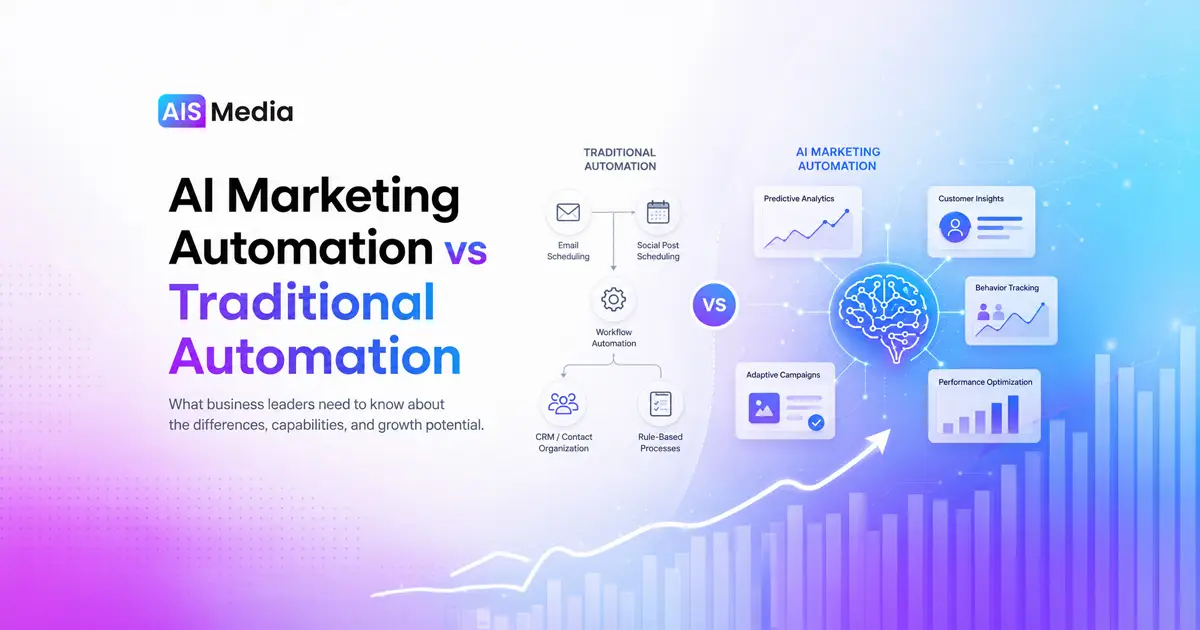
Traditional marketing automation uses fixed rules created by people.
For example:
- Send a welcome email after someone signs up.
- Send a reminder after three days.
- Move a customer to another email list after they make a purchase.
- Schedule social media posts every Monday.
Everything follows a predefined workflow.
This approach is reliable because every customer receives the same actions based on the same conditions.
Benefits of Traditional Automation
Traditional automation offers several advantages:
- Easy to set up
- Predictable results
- Saves time on repetitive tasks
- Works well for simple marketing campaigns
- Lower learning curve for marketing teams
Many businesses still rely on traditional automation because it handles routine tasks efficiently.
What Is AI Marketing Automation?
AI marketing automation takes automation much further.
Instead of following only fixed rules, artificial intelligence studies customer behavior and continuously looks for ways to improve marketing performance.
Rather than simply asking:
“If this happens, send Email A.”
AI asks:
“What is the best message to send this customer right now?”
It learns from data and adjusts automatically.
For example, AI can:
- Recommend products customers are most likely to buy
- Send emails when each customer is most likely to open them
- Create personalized content
- Improve advertising campaigns automatically
- Predict which customers may stop buying
- Suggest the next best marketing action
The system becomes smarter over time because it learns from previous results.
AI Marketing Automation vs Traditional Automation: The Biggest Differences
Although both approaches save time, they work very differently.
Traditional Automation
Traditional automation depends on rules.
Someone has to decide:
- When emails are sent
- Which message customers receive
- How leads move through the sales process
- What actions happen next
The system follows those instructions exactly.
AI Marketing Automation
AI uses customer data to make decisions.
Instead of fixed workflows, it can:
- Personalize messages
- Predict customer behavior
- Adjust campaigns automatically
- Recommend improvements
- Learn from campaign performance
This allows businesses to deliver more relevant marketing without manually updating every campaign.
Personalization Makes the Biggest Difference
Today’s customers expect personalized experiences.
Receiving the same email as thousands of other people is no longer enough.
Traditional automation can personalize basic information like:
- First name
- Company name
- Purchase history
AI goes much deeper.
It can personalize based on:
- Browsing behavior
- Products viewed
- Previous purchases
- Interests
- Location
- Device used
- Buying habits
- Engagement history
Instead of one message for everyone, AI helps deliver the right message to the right person at the right time.
AI Can Improve Campaigns Automatically
One of AI’s biggest advantages is continuous improvement.
Traditional automation requires marketers to review reports and make changes manually.
AI can analyze campaign performance while it is running.
For example, it may discover:
- One email subject line performs better.
- Customers prefer a different send time.
- One audience responds better to video.
- Certain ads generate more conversions.
The AI then adjusts future campaigns using those insights.
This helps marketers improve results without constantly making manual changes.
Which Saves More Time?
Both systems save time, but in different ways.
Traditional automation reduces repetitive tasks.
AI automation reduces repetitive tasks while also reducing manual decision-making.
Instead of constantly reviewing reports, testing campaigns, and making adjustments, AI can handle much of the optimization automatically.
Marketing teams can spend more time focusing on strategy and creative work.
Which Is Better for Small Businesses?
Many people assume AI is only for large companies.
That is no longer true.
Many marketing platforms now include AI features that small businesses can use without hiring data scientists or developers.
Small businesses can use AI to:
- Improve email marketing
- Generate content ideas
- Score sales leads
- Create customer segments
- Optimize online advertising
- Answer customer questions using AI chatbots
Businesses can often start small and expand as they grow.
Is Traditional Automation Still Useful?
Absolutely.
Traditional automation is still valuable for many everyday marketing tasks.
Examples include:
- Welcome email sequences
- Appointment reminders
- Newsletter scheduling
- Customer onboarding
- Event registrations
These processes rarely require advanced AI.
In fact, many businesses combine both approaches.
Traditional automation handles routine workflows while AI improves personalization and campaign performance.
This combination often delivers the best results.
When Should Businesses Use AI Marketing Automation?
AI becomes especially valuable when businesses want to:
- Increase conversions
- Improve customer engagement
- Personalize marketing
- Reduce manual campaign management
- Scale marketing across larger audiences
- Make better decisions using customer data
As customer expectations continue to grow, businesses that adopt AI can often respond faster and provide better customer experiences.
The Future of Marketing Automation
Marketing automation is evolving quickly.
Businesses are moving beyond simply automating tasks.
They now want systems that can:
- Learn from customer behavior
- Predict future actions
- Personalize every interaction
- Improve campaigns automatically
AI marketing automation makes this possible.
Rather than replacing marketers, AI helps them work more efficiently by handling data analysis, repetitive optimization, and personalization at a much larger scale.
Human creativity, strategy, and relationship-building remain essential, while AI supports faster and smarter decision-making.
Choosing Between AI Marketing Automation and Traditional Automation
When comparing AI marketing automation vs traditional automation, it’s important to understand that one does not completely replace the other. Instead, each serves a different purpose.
Traditional automation is ideal for handling routine, repeatable tasks that require consistency, such as sending welcome emails, scheduling social media posts, or managing customer workflows.
AI marketing automation builds on those capabilities by analyzing customer behavior, personalizing experiences, and continuously improving campaign performance based on real-time data.
For many businesses, the most effective strategy is to combine both approaches. Traditional automation keeps everyday marketing operations running efficiently, while AI helps improve customer engagement, optimize campaigns, and uncover new growth opportunities.
As AI becomes more accessible, businesses that start incorporating it into their marketing today will be better positioned to deliver personalized customer experiences and stay competitive in the years ahead.
Frequently Asked Questions About AI Marketing Automation VS Traditional Marketing Automation
What is AI marketing automation?
AI marketing automation uses artificial intelligence to analyze customer data, personalize marketing, and improve campaigns automatically.
How is AI different from traditional marketing automation?
Traditional automation follows fixed rules, while AI learns from customer behavior and adjusts marketing based on real-time data.
Is AI marketing automation expensive?
Many modern marketing platforms now include AI features that are affordable for small and medium-sized businesses.
Can small businesses benefit from AI marketing automation?
Yes. Small businesses can use AI for email marketing, customer segmentation, lead scoring, chatbots, and advertising optimization.
Should businesses replace traditional automation with AI?
Not necessarily. Most businesses benefit from using both. Traditional automation manages routine workflows, while AI improves personalization and campaign performance.