Artificial intelligence is transforming nearly every aspect of digital marketing, including how paid advertising campaigns are planned, optimized, and managed.
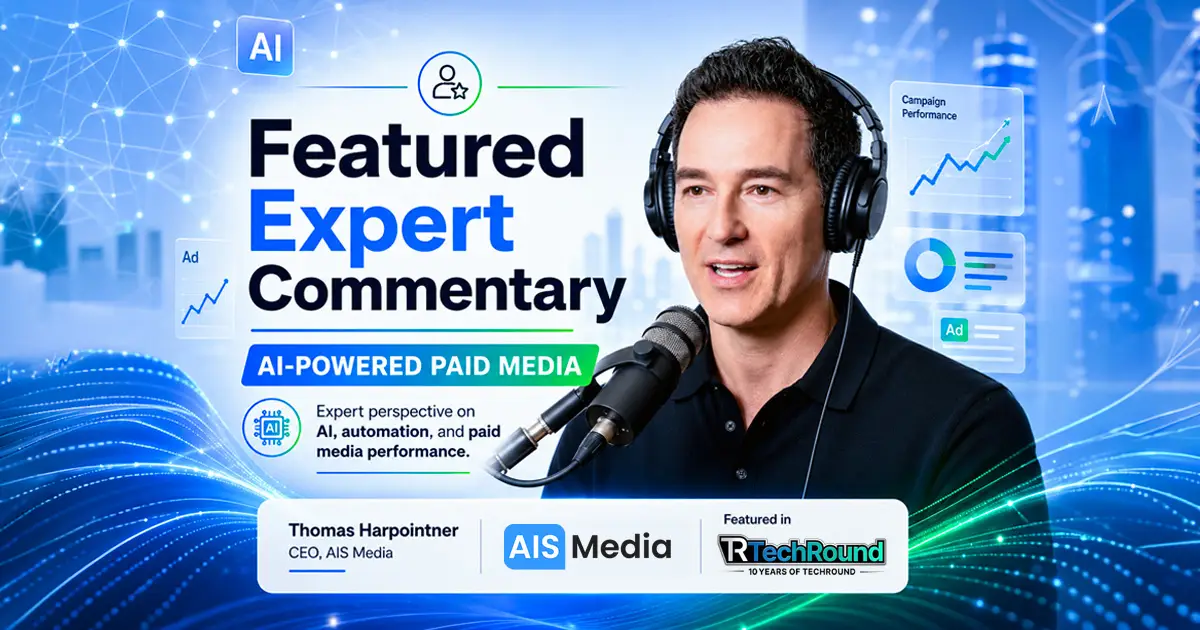
In a recent article published by TechRound, author Les-Leigh A. explored how AI is reshaping paid media and asked industry leaders whether businesses should embrace automation or proceed with caution. The article, “AI Is Running Your Paid Media Now. Here’s What The Experts Actually Think About That,” featured insights from marketing professionals and business leaders, including Thomas Harpointner, CEO of AIS Media Inc.
The discussion examined one of the most important questions facing advertisers today: As AI takes on a larger role in campaign management, where should businesses rely on automation and where is human expertise still essential?
Harpointner shared his perspective on how AI is changing paid advertising and why strategic oversight remains critical despite advances in machine learning.
AI Is Making Paid Media Faster and More Efficient
According to Harpointner, the biggest advantage of AI in paid media is not automation for its own sake. It is the ability to accelerate testing and creative development.
AI tools allow marketers to generate more ad variations, test more messaging angles, and identify winning creative concepts faster than ever before.
“The biggest gains are coming from creative speed,” Harpointner explained in the TechRound feature. AI helps marketers create more variations, reduce testing costs, and discover what resonates with audiences more quickly.
This ability to test and learn faster has become especially valuable as advertising platforms increasingly reward creative diversity and rapid iteration.
Why “Set It and Forget It” Is a Dangerous Mindset
While AI-powered tools such as Google Performance Max and Meta Advantage+ can deliver strong results, Harpointner cautioned against assuming automation can replace strategy.
AI systems require:
- Clean conversion tracking
- Accurate business goals
- Reliable first-party data
- Clear creative direction
Without those foundations, automation may simply scale inefficiencies rather than improve performance.
Many experts featured in the article shared a similar perspective: AI is highly effective when supported by strong strategy, but it becomes risky when marketers rely on it without oversight.
The Role of Human Expertise Is Changing
One of the most important themes from the TechRound discussion was that AI is not replacing marketers. Instead, it is changing where marketers create value.
As campaign execution becomes increasingly automated, strategic thinking becomes more important.
Harpointner noted that marketers now need a deeper understanding of:
- Brand positioning
- Customer behavior
- Audience intent
- Unique selling propositions
- Business objectives
AI can generate variations and optimize delivery, but it does not understand brand identity or business strategy on its own. Human guidance remains essential.
This aligns with a growing industry consensus that AI works best as an execution tool rather than a replacement for strategic decision-making.
Why Data Quality Matters More Than Ever
Another key takeaway from the discussion is that AI can only optimize toward the information it receives.
If conversion tracking is inaccurate or business goals are poorly defined, AI systems will optimize for the wrong outcomes.
As Harpointner explained, automation amplifies existing strengths and weaknesses. Strong data and clear objectives create better results. Weak inputs create bigger problems faster.
This makes first-party data, measurement accuracy, and disciplined testing increasingly important as AI takes on a larger role in campaign management.
The Future of Paid Media Is AI-Assisted, Not AI-Controlled
The TechRound article highlighted a consistent theme across industry experts: AI is becoming a permanent part of paid media, but human oversight remains essential.
The marketers seeing the strongest results are not handing control over to AI. They are using AI to improve efficiency while maintaining ownership of strategy, creative direction, and measurement.
For business leaders evaluating their advertising investments, Harpointner offered a straightforward recommendation:
Rather than increasing budgets simply because platforms are AI-powered, organizations should focus on disciplined testing, stronger creative development, and continuous optimization.
AI rewards advertisers who provide clear goals, quality data, and strategic direction. It does not eliminate the need for expertise.
About Thomas Harpointner
Thomas Harpointner is the CEO of AIS Media Inc. and a recognized authority in AI Search, Answer Engine Optimization (AEO), Generative Engine Optimization (GEO), SEO, and digital marketing strategy. He helps businesses adapt to changing technologies and improve visibility across both traditional and AI-powered channels.
He regularly shares insights on AI Search, digital marketing, and emerging technologies on X at https://x.com/TomHarpointner and on LinkedIn at https://www.linkedin.com/in/thomasharpointner/.
About AIS Media Inc.
AIS Media Inc. is an Atlanta-based digital marketing agency specializing in SEO, AI Search optimization, paid media strategy, and online visibility solutions.
The agency helps businesses improve performance through Local SEO, Core SEO Services, paid advertising management, Answer Engine Optimization (AEO), and Generative Engine Optimization (GEO).
Learn more at https://www.aismedia.com. Follow AIS Media on LinkedIn at https://www.linkedin.com/company/ais-media-inc/ and on X at https://x.com/aismedia.
About the TechRound Feature
The article, “AI Is Running Your Paid Media Now. Here’s What The Experts Actually Think About That,” was written by Les-Leigh A and published by TechRound. The feature gathered insights from marketing and business leaders to explore how artificial intelligence is changing paid advertising and what organizations should consider as automation becomes more prevalent.