
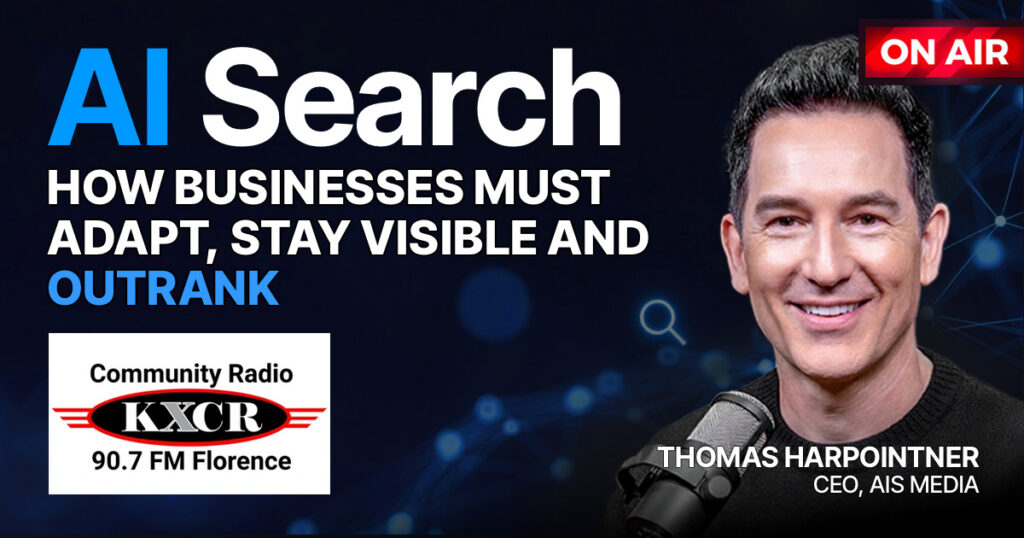
AIS Media CEO Thomas Harpointner appeared on KXCR Radio in a 30-minute interview with host Larry Bloomfield on March 5, 2025, addressing one of the most consequential shifts in digital marketing today: the rapid displacement of traditional SEO by AI-powered search and the emergence of Answer Engine Optimization (AEO). With Google’s AI Overviews now appearing on nearly half of all searches and average click-through rates to websites down 61%, Harpointner delivered a clear, urgent message to business owners adapt now or risk disappearing from the digital landscape entirely.
Thomas Harpointner, has spent over 20 years at the intersection of digital marketing and emerging technology. In this interview, he breaks down exactly what is happening to search, why it matters for every business with an online presence, and what steps organizations must take to remain visible and competitive in the age of AI-driven answers.
AI Search Is Changing the Way People Find Information
For decades, search engine optimization meant earning a top-ten ranking on Google’s results page. That era is ending. Since Google launched AI Overviews in May 2024, the results page itself has become the answer and millions of users never scroll further.
According to research from BrightEdge, AI Overviews grew 58% year-over-year and now appear on nearly half of all Google searches. On informational queries the questions people type when they want to learn something AI Overviews now appear on approximately 90% of searches. In sectors like healthcare, B2B technology, and restaurants, AI results trigger on 78% to 88% of queries.
The consequences for website traffic are severe. Data from Seer Interactive shows that average click-through rates to websites are down 61% on searches where AI Overviews appear. SparkToro research found that for every 1,000 U.S. Google searches, only 374 clicks actually reach a website.
“Search is no longer about ranking pages,” Harpointner stated during the interview. “It’s about becoming the trusted answer.”
What Is Answer Engine Optimization (AEO)?
Answer Engine Optimization, or AEO, is the practice of structuring content so that AI systems including Google’s AI Overviews, ChatGPT, Perplexity, and Gemini can identify it as a credible, citable source and surface it directly within AI-generated answers.
Where traditional SEO focused on keyword density, backlink volume, and page authority signals, AEO focuses on something more fundamental: trustworthiness and answer-readiness. AI systems are trained on human-created content, and they prioritize sources that demonstrate real knowledge, verifiable credentials, and structured, direct responses to user questions.
AEO is closely related to Generative Engine Optimization (GEO) a term used to describe strategies specifically designed to increase a brand’s visibility inside AI-generated responses across multiple platforms, not just Google.
Together, AEO and GEO represent the next evolution of search marketing and the businesses that master them early will hold a significant competitive advantage.
Why Businesses Must Adapt to AI Search Now
The shift to AI Search is not a future trend. It is happening now, at scale, and it is already redistributing online visibility in profound ways.
Harpointner emphasized during the KXCR interview that waiting is not a neutral choice. Every month that a business fails to optimize for AI Search is a month that competitors who are building authority, structured content, and E-E-A-T signals pull further ahead.
The businesses most at risk are those relying entirely on organic traffic from traditional SEO without any strategy for how AI systems evaluate and cite sources. As AI Overviews absorb more query results, the gap between businesses that have adapted and those that have not will widen rapidly.
Key reasons to act now:
- AI Overviews are already on ~90% of informational searches the queries most likely to bring new customers to a business
- CTR to websites is down 61% on searches with AI results, meaning organic rankings alone no longer guarantee traffic
- AI systems reward established trust signals the longer a business waits to build them, the longer it takes to compete
Key Strategies for Success in the Age of AI Search
During the interview, Harpointner outlined concrete, actionable strategies that businesses can implement to improve their visibility in AI-generated search results.
1. Build E-E-A-T Signals Into Every Piece of Content
An analysis of over 10,000 AI Overview citations found that approximately 85% of the most-cited sources displayed at least three of the four E-E-A-T signals: Experience, Expertise, Authoritativeness, and Trust. Author bios, professional credentials, first-hand experience sections, and verifiable sources are no longer optional content elements they are ranking factors for AI citation.
2. Apply the Three High-Impact GEO Tactics
Research into Generative Engine Optimization has identified three tactics that produce the greatest lift in AI citation rates:
- Adding statistics to content up to a 33.9% increase in citations
- Quoting named experts up to a 32% increase in citations
- Citing sources directly within content up to a 30.3% increase in citations
These tactics signal to AI systems that a source is substantive, credible, and grounded in verifiable information.
3. Write for Answer Engines, Not Just Search Engines
Content should be structured to directly answer specific questions with clarity and precision. AI systems scan content looking for clear, extractable answers — the same qualities that make content useful to human readers. Short paragraphs, defined terms, and direct responses to common questions are foundational to AEO-ready content.
4. Become a Trusted Source Not Just a Visible One
“The businesses that will win,” Harpointner said, “are the ones who are genuinely useful, visible, and trustworthy and who do the unglamorous work to prove it.” That means consistent publishing, expert attribution, structured data, and content that earns citation through quality rather than tricks.
The Future of Search: From Rankings to AI-Driven Answers
The trajectory is clear: AI-mediated search is becoming the default way people find information online. Google, ChatGPT, Perplexity, and Gemini are all expanding their AI answer capabilities, and each new development reduces the share of clicks that ever reach an organic result.
Businesses that treat AEO and GEO as supplementary to SEO rather than as the new core of their search strategy will find themselves increasingly invisible in the environments where their customers are actually searching.
The future of search visibility belongs to brands that AI systems trust enough to cite. Building that trust requires demonstrating real expertise, structuring content for machine extraction, and consistently signaling credibility through every layer of a digital presence.
How Media Appearances Build Authority and Trust in AI Search
Thomas Harpointner’s appearance on KXCR Radio with Larry Bloomfield reflects a broader pattern: the most visible authorities in the AI Search space are those who show up consistently across credible media platforms, not just in search results.
Media appearances on radio, podcasts, and broadcast journalism generate the kind of third-party authority signals that both human audiences and AI systems use to evaluate expertise. When an AI system is determining which sources to cite on a topic, mentions in established media outlets, interviews with credentialed hosts, and consistent public commentary all contribute to the authority profile that influences citation selection.
For business leaders navigating the AI Search transition, thought leadership is not just a branding exercise. It is a technical strategy one that directly feeds the E-E-A-T and authority signals that determine visibility in AI-generated answers.
About Thomas Harpointner
Thomas Harpointner is the CEO of AIS Media Inc. and a recognized authority in AI Search, Answer Engine Optimization (AEO), and Generative Engine Optimization (GEO). With decades of experience in digital marketing, he advises businesses across industries on how to adapt their strategies to the rapidly evolving search landscape shaped by artificial intelligence.
Harpointner is a sought-after media guest and industry voice, regularly appearing on radio programs, podcasts, and digital platforms to break down complex AI Search trends into clear, actionable insights for business leaders and marketing professionals.
He actively shares insights on emerging search technologies, AI-driven visibility, and digital strategy on his social platforms, including X at https://x.com/TomHarpointner and LinkedIn at https://www.linkedin.com/in/thomasharpointner/.
About AIS Media Inc.
AIS Media Inc. is an Atlanta-based digital marketing agency specializing in AI Search optimization, SEO, and performance-driven online visibility strategies. As search continues to evolve with the rise of generative AI, AIS Media helps businesses transition from traditional SEO approaches to advanced strategies built around AEO and GEO.
The agency provides a full spectrum of services designed to improve both traditional and AI-powered search visibility, including local SEO for geographic dominance, core SEO services for rankings and eCommerce growth, and advanced SEO strategies that integrate Answer Engine Optimization and Generative Engine Optimization.
Businesses can learn more about AIS Media’s services and approach by visiting https://www.aismedia.com, where they can explore solutions tailored to the modern search environment.
AIS Media also shares insights, updates, and thought leadership across social platforms, including X at https://x.com/aismedia and LinkedIn at https://www.linkedin.com/company/ais-media-inc/, helping brands stay informed and competitive in the age of AI-driven search.
Is your business ready for the AI Search era? Contact AIS Media today to learn how Answer Engine Optimization and Generative Engine Optimization can protect and grow your online visibility.