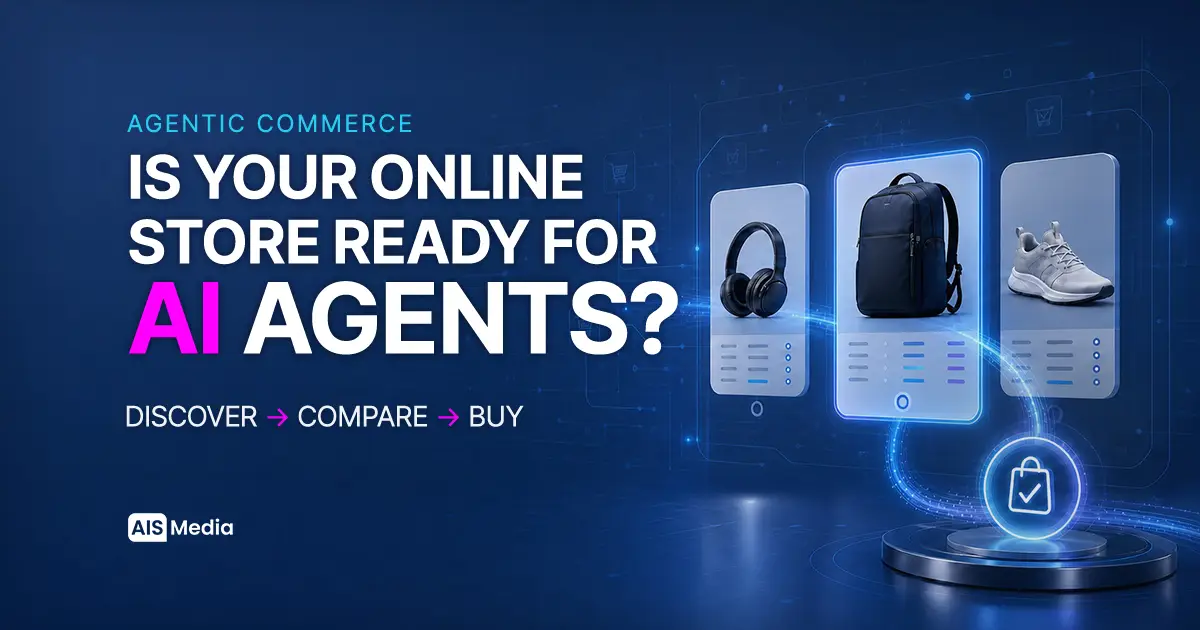
The next ecommerce customer may never browse your category page, open your navigation, or read your product page from top to bottom. An AI shopping agent may do that work instead.
That shift is already underway. Agentic commerce is moving product discovery, comparison, cart building, and purchasing into AI interfaces. For ecommerce brands, that creates a new optimization requirement: your store must be understandable and actionable by machines as well as people.
What is agentic commerce?
Agentic commerce is ecommerce in which AI agents discover, compare, recommend, and sometimes purchase products on a customer’s behalf. Instead of relying only on human browsing, brands provide structured product data, accurate merchant feeds, accessible commerce systems, and machine-readable content that AI shopping agents can interpret and act on.
This is no longer a distant technology bet. Google, Amazon, OpenAI, Shopify, Walmart, and other major commerce companies have already deployed pieces of the infrastructure.
The brands that prepare now can compete for visibility before AI-mediated shopping becomes another crowded acquisition channel.
Why Is Agentic Commerce Becoming Important Now?
Agentic commerce matters now because AI systems are moving from answering shopping questions to taking shopping actions. Product discovery, comparison, cart creation, price monitoring, and checkout are increasingly happening inside AI-powered interfaces.
Google introduced the Universal Commerce Protocol, or UCP, in January 2026. Google developed the open standard with Shopify, Etsy, Wayfair, Target, Walmart, and other commerce companies. It gives agents and commerce systems a common way to communicate across discovery, buying, and post-purchase activity.
Google has continued expanding UCP. Its Catalog capability can provide agents with real-time product information such as variants, pricing, and inventory. Google also introduced Universal Cart and continues bringing agentic commerce features into Search and Gemini.
Amazon is moving in the same direction. Its AI shopping assistant, previously called Rufus and renamed Alexa for Shopping in May 2026, can compare products, build carts, track prices, and automate some purchases. Amazon’s Shop Direct also surfaces products from stores outside Amazon. Eligible products can use Buy for Me, where Amazon’s agentic AI completes purchases from participating merchant websites.
OpenAI has also moved commerce into ChatGPT. It launched Instant Checkout and the Agentic Commerce Protocol with Stripe in 2025. OpenAI has since shifted its broader commerce strategy toward product discovery and merchant-controlled checkout experiences, while still supporting deeper app integrations. Walmart, for example, introduced an in-ChatGPT shopping experience.
Shopify has made agentic storefronts available across channels including ChatGPT, Google AI Mode, Gemini, and Microsoft Copilot for eligible merchants. Its Catalog API and UCP infrastructure give developers structured access to commerce data and transaction flows.
The direction is clear.
Search engines once sent shoppers to stores. AI systems increasingly help decide which products deserve consideration before a store visit happens at all.
That changes what ecommerce optimization needs to accomplish.
How Does Agentic Commerce Change Ecommerce Optimization?
Traditional ecommerce optimization assumes a person reaches the website and then makes a decision.
Agentic commerce adds another audience: software.
An AI agent needs enough reliable information to determine whether a product meets its user’s constraints. Those constraints may be highly specific.
Consider this request:
“Find a waterproof carry-on backpack under $180 that fits a 16-inch laptop, weighs under three pounds, ships by Friday, and has at least a two-year warranty.”
A beautiful lifestyle photograph cannot answer that request alone.
The agent needs structured facts about price, dimensions, laptop compatibility, material, availability, shipping, warranty, and other attributes. Missing information creates uncertainty. When another retailer supplies clearer data, that product becomes easier for an agent to evaluate.
That produces a fundamental difference between traditional and agentic optimization.
| Traditional Ecommerce Optimization | Agentic Commerce Optimization |
|---|---|
| Optimizes pages primarily for human visitors | Optimizes product information for humans and AI agents |
| Prioritizes UX, navigation, persuasion, and CRO | Adds structured data, feeds, APIs, and machine-readable attributes |
| Relies heavily on page copy and imagery | Relies on structured facts plus clear product content |
| Treats product feeds mainly as advertising infrastructure | Treats feeds as a core product discovery layer |
| Sends shoppers through conventional website checkout | Supports agent-assisted and agentic checkout |
| Measures sessions, CTR, conversion rate, and ROAS | Adds AI visibility, agent referrals, product inclusion, and agent-driven sales |
| Updates inventory primarily for onsite shoppers | Synchronizes inventory and pricing across machine-accessible systems |
The two approaches are not competitors. Brands still need excellent UX and persuasive merchandising.
However, the underlying product data now matters much more.
AIS Media’s SEO services already address visibility across traditional and AI-powered search. Agentic commerce extends that challenge from content visibility into product discovery and transaction infrastructure.
What Product Data Do AI Shopping Agents Need?
AI shopping agents perform better when product facts are explicit, structured, current, and consistent across the website, feeds, and commerce systems. Brands should prioritize identifiers, variants, price, availability, dimensions, materials, shipping, returns, and product-specific attributes.
Four areas deserve immediate attention.
1. Strengthen Product and Offer Structured Data
Product structured data gives machines explicit information about what a page sells.
For ecommerce product pages, Google supports Product structured data and merchant listing markup. Relevant Schema.org and Google-supported properties can describe information such as:
- Product name
- SKU and GTIN
- Brand
- Description
- Images
- Price and currency
- Availability
- Condition
- Variants
- Shipping information
- Return policies
- Ratings and reviews
A terminology note matters here. Teams sometimes refer broadly to “Merchant schema.” In Google’s documentation, merchant listing structured data primarily uses Product and Offer-related markup, with supporting properties and types for details such as shipping and merchant return policies. It is not simply a standalone Merchant schema type that solves agentic readiness.
Google recommends combining product structured data with Merchant Center feeds. Doing both gives Google more information to understand and verify products.
Consistency is critical.
If your schema says an item costs $149, your feed says $139, and the page shows $159, machines must reconcile conflicting information. That weakens confidence and can also create Merchant Center issues.
2. Complete Product Attributes
Basic schema implementation is only the starting point.
AI shopping agents answer detailed questions. Therefore, product attributes should reflect the actual criteria customers use when comparing products.
For furniture, that might include dimensions, materials, weight capacity, finish, assembly requirements, and warranty.
For electronics, it could include battery life, connectivity, compatibility, storage, dimensions, ports, and included accessories.
Google’s Merchant Center documentation specifically supports a product_detail attribute for additional technical specifications. Google states that this structured information can improve product discovery across AI-driven surfaces such as AI Mode.
Attribute completeness should therefore become a measurable ecommerce KPI.
A catalog with 95% complete product attributes gives machines more usable evidence than one filled with generic descriptions and blank specification fields.
Why Do Merchant Feeds Matter for Agentic Commerce?
Merchant feeds give AI-driven commerce platforms structured, scalable product information. Clean feeds improve the ability of systems to match products with specific shopping requests, while stale prices, missing attributes, and inventory mismatches reduce confidence.
For many ecommerce teams, Google Merchant Center has historically belonged to the paid media department.
That mindset needs to change.
Merchant feeds are becoming part of the information infrastructure behind AI-driven commerce.
Google Merchant Center already accepts detailed attributes covering identifiers, descriptions, price, availability, dimensions, shipping, and product specifications. Its 2026 product data updates added further shipping-related attributes.
At Google Marketing Live 2026, Google also announced conversational attributes designed to help retailers describe products according to the more conversational ways people search across AI experiences.
Feed Hygiene Becomes an AI Visibility Issue
Retailers should audit:
- GTIN, MPN, SKU, and brand coverage
- Variant relationships
- Product titles
- Product descriptions
- Product type and category
- Price and sale price
- Inventory availability
- Color, size, material, and pattern
- Shipping information
- Product dimensions
- Product details and specifications
Then check synchronization.
A product that sold out three hours ago should not remain marked in_stock in systems used by shopping agents.
Real-time or near-real-time synchronization becomes increasingly important as autonomous purchasing develops. An agent cannot reliably transact against yesterday’s inventory.
The same principle applies beyond Google. Amazon announced in 2026 that merchants can connect catalogs to its Shop Direct program through third-party feeds from providers including Feedonomics and Salsify.
Product feed optimization is becoming platform-independent commerce infrastructure.
Are Your Ecommerce APIs Ready for AI Shopping Agents?
API readiness means AI-enabled commerce systems can retrieve accurate product, inventory, pricing, cart, and checkout information programmatically. The goal is not to expose every backend system. It is to create controlled interfaces that let authorized agents perform defined commerce actions safely.
Machine-readable discovery solves only half the problem.
The next stage is action.
An agent may need to ask:
Is this SKU available?
What does it cost right now?
Can it ship to ZIP code 30305 by Thursday?
Can I add two units to a cart?
What is the final price after tax and shipping?
Can this customer use a loyalty benefit?
Can I submit the order?
Those questions require live systems.
Build Around Core Commerce Functions
Ecommerce technology teams should evaluate API support for:
Product APIs: Return canonical product records, variants, specifications, media, and identifiers.
Inventory APIs: Return current stock status by SKU, location, or fulfillment channel.
Pricing APIs: Provide current prices, promotions, customer-specific offers, and currencies.
Cart and checkout APIs: Allow authorized systems to create carts, calculate totals, submit shipping information, and initiate transactions.
Security and permissions remain essential. Autonomous purchasing does not mean giving unknown bots unrestricted checkout access.
Emerging protocols are addressing this problem. Google’s UCP creates standardized commerce interactions, while its Agent Payments Protocol focuses on authorization and accountability for agent-led payments.
The objective is controlled interoperability.
For brands planning broader digital transformation, AIS Media’s digital marketing strategy services can connect search visibility, content, customer acquisition, and emerging AI discovery requirements to a unified roadmap.
How Should Product Content Change for AI Shopping Agents?
AI-readable product content states important facts clearly and consistently so machines can extract them without inference. Strong content answers specific buying questions about use cases, compatibility, dimensions, materials, performance, shipping, warranties, and limitations.
Human persuasion still matters. However, vague marketing language creates problems for machines.
Consider:
“Our premium everyday backpack blends innovative design with exceptional versatility.”
That sounds polished. It communicates almost nothing useful to a shopping agent.
Compare it with:
“The 28-liter backpack fits laptops up to 16 inches, weighs 2.4 pounds, uses a water-resistant recycled nylon shell, and includes a padded laptop compartment.”
Now an AI system can match facts against purchase criteria.
Write for Extraction Without Making Copy Robotic
Product pages should include concise specification tables, descriptive headings, FAQs, compatibility information, shipping details, and explicit answers to common buying questions.
Use consistent terminology as well.
If your feed calls a finish “Natural Walnut,” schema says “Walnut Brown,” and page copy calls it “Dark Wood,” you create unnecessary ambiguity.
Machine readability rewards precision.
AIS Media’s content development services can support this shift by combining search-focused copy with content structures designed for AI extraction.
Agentic Commerce Readiness Checklist
Ecommerce leaders do not need to rebuild their technology stack tomorrow. They do need to understand where their gaps are.
Use this checklist as a starting point:
- Validate
ProductandOfferstructured data across product templates. - Add relevant merchant listing properties for shipping, returns, variants, and availability.
- Audit GTIN, SKU, MPN, brand, size, color, material, and other key attributes.
- Compare onsite product data against Merchant Center feeds for inconsistencies.
- Increase feed coverage for optional but decision-relevant attributes.
- Implement reliable inventory and price synchronization.
- Review product, pricing, inventory, cart, and checkout API capabilities.
- Evaluate UCP and other relevant commerce protocol support.
- Rewrite vague product descriptions around verifiable product facts.
- Add structured specification tables to important product pages.
- Answer common pre-purchase questions directly on product pages.
- Document shipping, returns, warranties, and compatibility clearly.
- Track traffic and conversions from emerging AI shopping channels.
- Test how major AI assistants describe and compare your products.
- Assign ownership for agentic commerce readiness across SEO, ecommerce, engineering, and paid media teams.
Start with high-revenue categories rather than the entire catalog.
That creates a controlled environment for measuring how data improvements affect visibility and conversion.
What Should Ecommerce Leaders Do Next?
Agentic commerce readiness should receive budget now because the underlying work already improves existing channels.
Better schema helps search engines, while cleaner feeds improve Shopping visibility. Complete attributes strengthen product matching, and dependable APIs improve integrations. In addition, clearer product content supports both customers and AI systems.
That makes the investment useful even before agent-driven purchases represent a large percentage of revenue.
The larger risk is waiting until AI shopping channels mature and then discovering that thousands of SKUs have incomplete attributes, inconsistent feeds, inaccessible inventory systems, and product descriptions that agents cannot reliably interpret.
Brands spent years learning how to optimize websites for search engines and people.
The next requirement is making the entire commerce layer understandable to software acting for those people.
That work should start now.
Frequently Asked Questions About Agentic Commerce
What is agentic commerce?
Agentic commerce uses AI agents to assist or execute ecommerce tasks for shoppers. These tasks can include product discovery, comparison, price monitoring, cart creation, and purchasing based on user-defined requirements.
How is agentic commerce different from conversational commerce?
Conversational commerce focuses on interactions through chat or messaging. Agentic commerce goes further because an AI system can take actions, such as retrieving live inventory, creating a cart, monitoring prices, or completing an authorized purchase.
What is an AI shopping agent?
An AI shopping agent is software that interprets a customer’s requirements and performs shopping tasks on that person’s behalf. Depending on the platform, it may research products, compare options, build carts, track prices, or initiate purchases.
Does agentic commerce replace ecommerce SEO?
No. SEO remains important because search engines and AI systems still need accessible, authoritative product information. Agentic commerce expands SEO by adding structured product data, feeds, APIs, and transaction readiness.
What structured data should ecommerce stores use for agentic commerce?
Stores should start with accurate Product and Offer markup and relevant merchant listing properties. They should include identifiers, price, availability, variants, shipping, returns, and other applicable product information.
How can brands prepare for AI-driven commerce now?
Start by auditing product schema, Merchant Center feeds, attribute completeness, inventory synchronization, APIs, and product content. Then prioritize high-value categories and test whether AI shopping systems can accurately find, understand, compare, and recommend those products.
Prepare Your Store for the Next Ecommerce Interface
The ecommerce interface is expanding beyond websites, marketplaces, and search results. AI shopping agents are becoming another layer between customer intent and the purchase.
Brands that provide clean data, accessible systems, and precise product information will give those agents more reasons to select them.
Brands that remain difficult for machines to understand risk becoming difficult for customers to discover.
AIS Media helps established brands build digital strategies for traditional search, AI-powered discovery, content performance, and emerging customer acquisition channels.
Contact AIS Media to discuss an agentic commerce and ecommerce readiness assessment for your brand.