
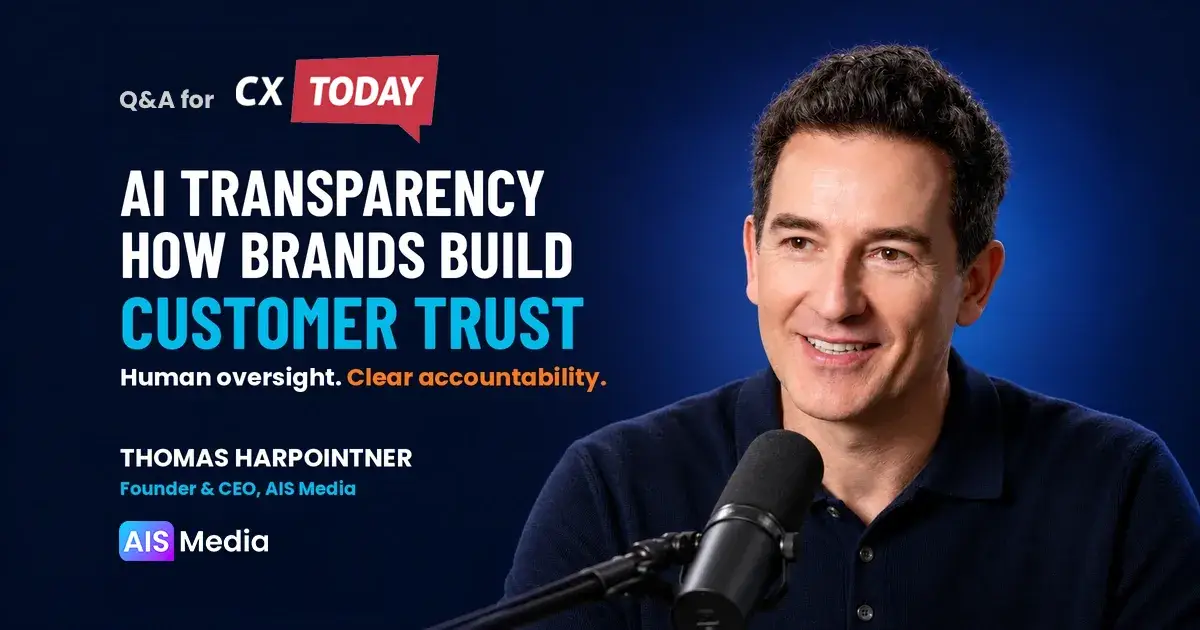
CX Today reached out to AIS Media founder and CEO Thomas Harpointner for his perspective on how brands should approach AI transparency, meaningful human oversight and organizational accountability. His responses, prepared for CX Today, address a growing concern for CMOs and business leaders: as artificial intelligence shapes what customers see, believe and decide, transparency becomes a matter of brand governance and trust.
Drawing on more than two decades advising growth-focused brands on digital strategy and buyer behavior, Harpointner explains why disclosure should follow impact. The greater AI’s influence on a customer decision, the clearer a brand should be about the technology’s role and the people accountable for the outcome.
How important is AI transparency for maintaining customer trust?
AI transparency should follow impact, not simply tool usage.
Transparency becomes important when AI materially shapes what a customer sees, believes or decides. If a brand uses a synthetic spokesperson, an automated agent, personalized advice or AI-generated claims, customers should understand the role the technology played.
However, not every minor use of AI requires a prominent label. Using AI to brainstorm, improve grammar, summarize research or accelerate production is different from allowing it to independently create and deliver a customer-facing experience.
The most responsible approach is proportional disclosure. Brands should provide enough information for customers to understand the nature of the interaction without overwhelming them with technical details.
Ultimately, trust will depend less on whether a company uses AI and more on whether it communicates honestly, reviews the output carefully and accepts responsibility for the final result.
Do AI-generated content labels strengthen customer trust?
A label without context can create suspicion instead of trust.
The term “AI-generated content” covers a broad spectrum, from a grammar correction to an entirely synthetic video. Treating every use of AI the same could confuse customers and create unnecessary skepticism around content that was responsibly developed and reviewed by people.
A more useful approach is to explain AI’s role in plain language. For example, “created with AI assistance and reviewed by our team” gives customers more meaningful information than a generic label.
More visible disclosure is appropriate when AI creates a synthetic person or voice, communicates directly with customers, generates testimonial-style content or produces information that could meaningfully influence a decision.
Effective transparency should clarify who is responsible. It should not allow a brand to shift responsibility to the technology. Whether AI assisted with one sentence or an entire campaign, the company publishing the content must still stand behind it.
How can brands use AI while keeping customer interactions human-centered?
AI should amplify human service, not impersonate it.
AI can help brands respond more quickly, surface relevant information, personalize recommendations and give employees better context about customer needs. Used well, it removes friction and allows teams to spend more time on conversations that require judgment, creativity or empathy.
The problems begin when automation is designed to mislead customers into believing they are interacting with a person or when it prevents them from reaching one.
To support AI transparency, brands should maintain a recognizable voice, clearly identify automated interactions when appropriate and provide an easy path to a real employee when a situation becomes sensitive, complex or consequential.
Customers may be comfortable with automation, but they still expect the company to remain accountable. The strongest customer experiences will combine AI’s speed and scale with the empathy, context and judgment that only people can provide.
When should brands disclose their use of AI?
The key question is not how much AI was used. It is whether knowing about it would change how a reasonable customer interprets the experience.
The AIS Media AI Transparency Materiality Test
Before deciding whether disclosure is necessary, brands should ask four questions:
- Could AI mislead the customer about the source or authenticity of an interaction?
- Could the output materially influence a customer’s decision?
- Has a qualified person reviewed and approved the result?
- Can the customer reach a real person when judgment or empathy is required?
If knowing that AI was involved would materially change how a reasonable customer interprets the experience, the brand should disclose its role clearly.
Disclosure becomes more important when AI creates a synthetic identity or voice, operates as an autonomous customer-facing agent, produces testimonial-style content, makes consequential recommendations or generates claims without meaningful human review.
Routine assistance, such as brainstorming, editing, translation, formatting or summarization, may not require prominent labeling when a qualified person reviews and approves the final result.
For hybrid content, clear wording such as “developed with AI assistance and reviewed by our team” can provide appropriate context. The objective is not to calculate what percentage was produced by AI. It is to ensure customers are not given a false impression of authenticity or human involvement.
What principles should brands follow for responsible AI transparency?
Brands can automate execution, but they cannot automate accountability.
A responsible AI strategy should follow several principles:
- Put the customer’s interests first. AI should improve the experience, not merely reduce costs or increase output.
- Make disclosure proportional and useful. Explain AI’s role when it could affect how customers interpret an interaction or decision.
- Maintain human ownership. A qualified person should remain accountable for customer-facing content, claims and outcomes.
- Protect privacy and consent. Customer information should be handled carefully and used only for appropriate purposes.
- Review for quality and accuracy. AI-generated material should be checked for factual errors, bias, tone, context and brand alignment.
- Provide access to a person. Customers should have a clear escalation path when judgment or empathy is required.
- Monitor and improve. Brands should regularly evaluate their AI systems and correct problems quickly.
This approach aligns with the NIST AI Risk Management Framework, which treats transparency and accountability as essential characteristics of trustworthy AI.
With strong AI transparency, companies can communicate with greater speed, relevance and scale. The brands that earn lasting trust will be those that adopt AI confidently while remaining honest about its role and accountable for the experience they deliver.
For CMOs evaluating AI across marketing and customer experience, AIS Media helps growth-focused companies align digital strategy, content and AI-enabled marketing with brand trust and accountable performance.
About Thomas Harpointner
Thomas Harpointner is the founder and CEO of AIS Media, an award-winning digital marketing agency. For more than two decades, he has advised growth-focused brands on digital strategy and buyer behavior. Thomas is a frequent business media commentator nationwide on radio programs and he has appeared on CNBC, Fox Business, Bloomberg, NBC’s TODAY and CBS. His insights have also been featured or quoted in Inc., Forbes, Entrepreneur, TechRound and many other publications.
About AIS Media
AIS Media is an award-winning digital marketing agency helping growth-focused brands become known, found, trusted and chosen. Its integrated Digital Marketing Strategy, SEO Services and PPC Management programs increase visibility, generate qualified leads and drive measurable growth.