

To scale SEO content creation without compromising quality, build a repeatable process for research, writing, review, and measurement. Each new page should answer a distinct customer question and meet the same editorial standards. Publishing more pages alone does not make a content program successful.
For a marketing leader, the goal is useful content that supports qualified demand. Start with the topics your buyers need, give the team clear briefs, and set a realistic pace. Then use search and conversion data to guide the next round of work.
What Is SEO Content Scaling?
Content scaling means increasing useful output through a process the team can repeat. It may include new articles, stronger service pages, and updates to existing resources. However, every page still needs a clear purpose, reliable information, and a useful next step.
For example, a company may turn one broad topic into several distinct customer guides. Each guide should solve a different problem. In contrast, publishing near-identical articles for slight keyword changes adds volume without adding much value.
Why SEO Content Quality Matters
A strong digital marketing strategy connects content to business needs. Helpful pages can explain services, answer buying questions, and give prospects evidence for a decision. As a result, your team has a better basis for choosing what to publish.
Google’s people-first content guidance emphasizes useful, reliable information. It does not prescribe a preferred word count. Therefore, do not assume that a longer article or a faster publishing schedule will improve rankings. Use enough detail to complete the reader’s task.
To scale SEO content creation responsibly, protect the work that makes each page worth reading. That includes relevant expertise, clear examples, source checks, and an editor who can reject weak drafts.
How to Scale SEO Content Creation in 10 Steps
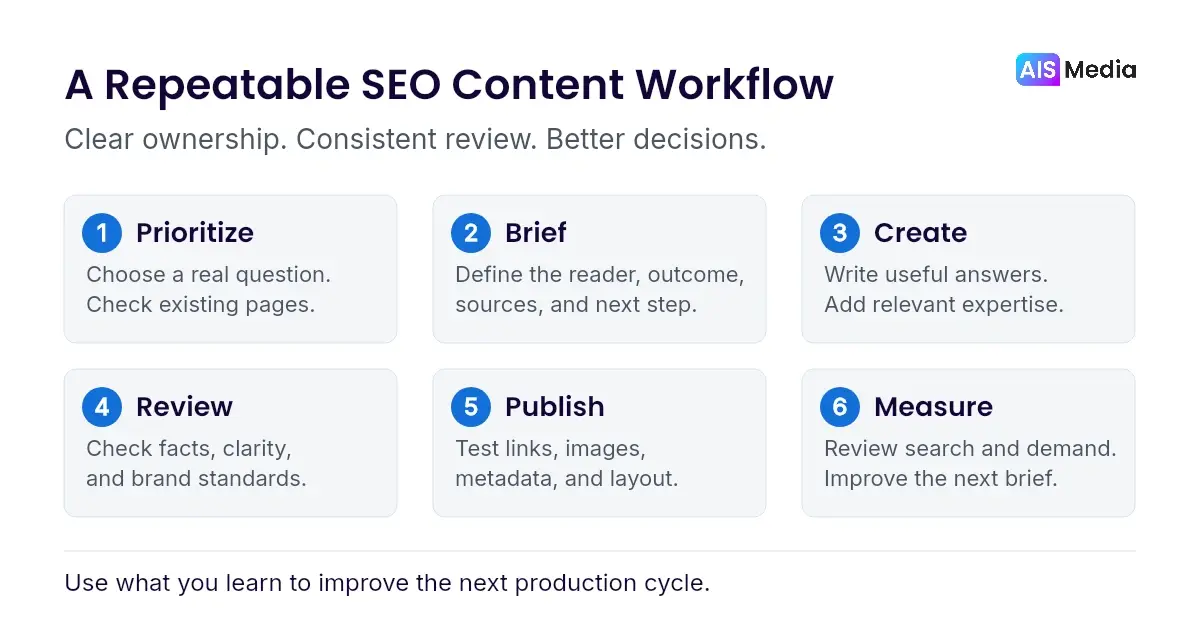
Use the workflow below to move from topic selection to performance review. First, test it on a manageable batch. Then fix delays and review gaps before increasing the number of assignments.
1. Audit Existing Pages Before Adding New Content
First, review the pages you already have. Record their purpose, target audience, search intent, and performance. Group pages by topic so you can spot gaps and overlap. Updating a useful page may be a better choice than starting another article.
For example, check whether an existing guide already answers the proposed question. If it does, improve that guide. This step helps prevent competing pages and gives new briefs a clearer role.
2. Build Briefs for Scalable SEO Content
Next, give every assignment a brief. Include the reader’s question, intended outcome, main topic, outline, source requirements, and next step. Also list relevant internal pages and the expert who will review the draft.
A content calendar should show more than publish dates. Add an owner, review deadline, approval status, and planned refresh date. As a result, the team can see delays before they affect the schedule.
3. Assign Owners to Your Content Scaling Workflow
Separate the roles of researcher, writer, editor, subject expert, and publisher. One person may cover several roles in a small team. However, each task still needs a named owner and a clear handoff.
To scale SEO content creation, make approval rules easy to follow. For instance, require source checks before the editor approves a draft. Then confirm that the publisher has checked links, images, and search settings.
4. Set Editorial Standards for Content Scaling
Create a short style guide with examples of your preferred voice, headings, links, and calls to action. In addition, define how writers should handle claims, sources, product details, and original examples. A reusable checklist makes these standards easier to apply.
Keep the brief focused on the reader. Use the main phrase where it helps explain the topic, and vary the wording naturally. Avoid adding keywords to every heading or repeating the same phrase in each paragraph.
5. Use AI With Human Review
AI can help organize notes, suggest outlines, and create a starting draft. However, it can also invent facts or repeat generic advice. As you scale SEO content creation, an editor should verify each claim and add useful business context.
Google’s scaled content abuse policy addresses pages produced mainly to manipulate rankings rather than help users. This applies regardless of how the content was created. Therefore, use automation to support accountable editorial work.
6. Match Content Depth to Search Intent
Answer the main question early. Then add the examples, steps, or comparisons the reader needs to act. A brief answer may suit a simple question. In contrast, a complex buying decision may need a detailed guide.
Do not stretch a draft to reach an arbitrary word count. Instead, remove repetition and fill real information gaps. Clear headings, short paragraphs, and useful visuals make the material easier to scan.
7. Apply SEO Content Quality Checks
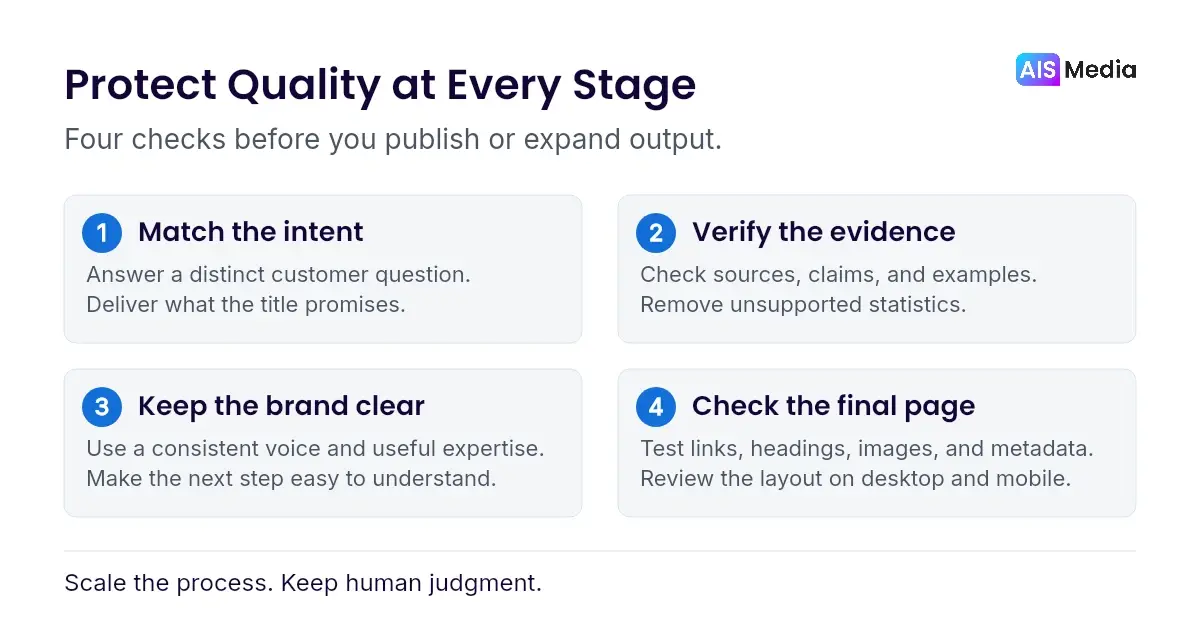
Before approval, check intent, evidence, brand clarity, and publishing details. The editor should verify that the page delivers what its title promises. Also check every statistic, quotation, product claim, and example against a reliable source.
- Intent: Does the page answer a distinct customer question?
- Evidence: Can readers trace important claims to a current, reliable source?
- Brand: Does the draft use a clear voice and add useful expertise?
- Publishing: Do links, headings, images, metadata, and mobile layout work?
8. Refresh and Repurpose Useful Content
Review older pages for missing answers, outdated advice, and weak examples. Then update the content that still serves a useful purpose. Preserve a working URL when the page continues to address the same topic.
You can also adapt an approved article into an email, a sales resource, or a social post. However, rewrite it for that format and audience. Reusing the underlying research should save work without creating repetitive pages.
9. Connect Content to Distribution and Demand
Publishing is one step in the process. Add relevant internal links so readers can find related answers and services. For example, link a practical guide to the next resource a buyer may need.
Also share useful articles through your existing email and social channels. Give each version a clear reason to read the full resource. Finally, align the next step with the topic, whether that means another guide or a consultation.
10. Measure Results Before Scaling Further
Use Search Console performance reports to review clicks, impressions, queries, and pages. Then compare similar periods and separate new articles from updated ones. Search metrics show discovery and visits; they do not measure every business outcome.
As you scale SEO content creation, track editorial results as well. Measure time to publish, review delays, and repeat revisions. In addition, use analytics and your sales records to assess qualified inquiries and conversions.
If output grows but useful engagement and qualified demand do not, revisit the topics, distribution, and conversion path. Increase volume only after the process can protect quality and support the goals you set.
SEO Content Scaling FAQ
Start with a small batch and a shared brief. Then assign an editor, check sources, and require approval before publishing. Increase output only when the team can meet the same quality checks on every page.
Yes. AI can support research planning, outlines, and early drafts. However, an editor should verify facts, add useful expertise, and protect the brand voice. Do not publish unchecked drafts simply to increase page counts.
Choose a schedule your team can sustain with proper research and review. For example, one useful article each week may be a better starting point than daily drafts with little substance. Review existing pages as well as new work.
Write enough to answer the reader’s question clearly. There is no fixed word count that guarantees rankings. Instead, use the topic, audience, and task to decide how much detail the page needs.
Map each topic and search intent to an existing or planned URL. Before approving a new brief, check for overlap. If two pages serve the same purpose, update or combine them rather than publishing another similar article.
Track production time and revisions alongside Search Console clicks and impressions. Also measure qualified inquiries, conversions, and the pages that support them. Compare similar periods so seasonal shifts do not distort the review.
Make Content Scaling Sustainable
To scale SEO content creation, standardize the process while keeping judgment in the review. Start with a focused topic plan, use clear briefs, and give editors enough time to check the work. Then improve the program using both search data and business results.
AIS Media helps businesses connect organic search strategy, editorial production, and measurement. If your team needs a clearer plan for growing output while protecting quality, talk with AIS Media about your goals.