

The AI Search Revolution Is Here. Is Your Business Prepared?
Artificial Intelligence (AI) is fundamentally altering how consumers search, shop, and engage with businesses online. For business owners and Chief Marketing Officers (CMOs), this shift is not just a trend—it’s a seismic transformation in digital marketing and search engine optimization (SEO). This article offers an AI search strategy that CMOs and business owners can use to lift SEO rankings and site traffic.
AI-driven platforms like Google Gemini, ChatGPT, and Microsoft Copilot are becoming the new gatekeepers of online information. They’re reshaping how customers interact with digital content, delivering instant, conversational answers that often bypass traditional search engine result pages.
A Harvard Business Review report notes that AI agents are informing purchase decisions and beginning to execute them autonomously. As this becomes more normalized, brands not integrated into AI-optimized ecosystems risk losing visibility and sales.
If your business does not appear in AI-powered interactions, competitors may gain an advantage during customer discovery and evaluation.
What This Article Will Teach You
- How AI search is reshaping traditional SEO strategies
- The impact of AI on your brand’s discoverability and traffic
- Ten proven strategies to future-proof your digital presence
- How to position your business as a trusted source in AI search
- How to measure and track your AI search visibility
What Is AI Search?
AI search refers to the use of artificial intelligence tools and algorithms to interpret, deliver, and sometimes even summarize online information in response to user queries. Unlike traditional search engines, which rely heavily on keyword matching and ranking signals, AI search engines interpret intent, context, and semantics.
AI search doesn’t just return a list of links — it offers complete answers, curated insights, or even personalized recommendations based on large language models (LLMs) and contextual learning.
Examples include:
- ChatGPT or Google Gemini summarizing an entire website’s content to answer a user’s question
- Voice assistants like Siri or Alexa recommend services based on past behavior
- AI agents booking services or making purchases automatically on behalf of users
1. Optimize for Conversational Search
AI-powered search tools are designed to understand and respond to natural language queries. Instead of typing “best local dentist,” consumers now ask, “Who’s the highest-rated dentist near me that accepts Delta Dental and offers same-day crowns?”
This shift requires businesses to anticipate and match questions in how customers ask them.
How to adapt:
- Use natural language and long-tail keywords
- Develop content that answers specific customer questions
- Include FAQ sections targeting “how,” “what,” “why,” and “where” questions
- Add user intent–driven headlines such as “What’s the best option for…”
Example:
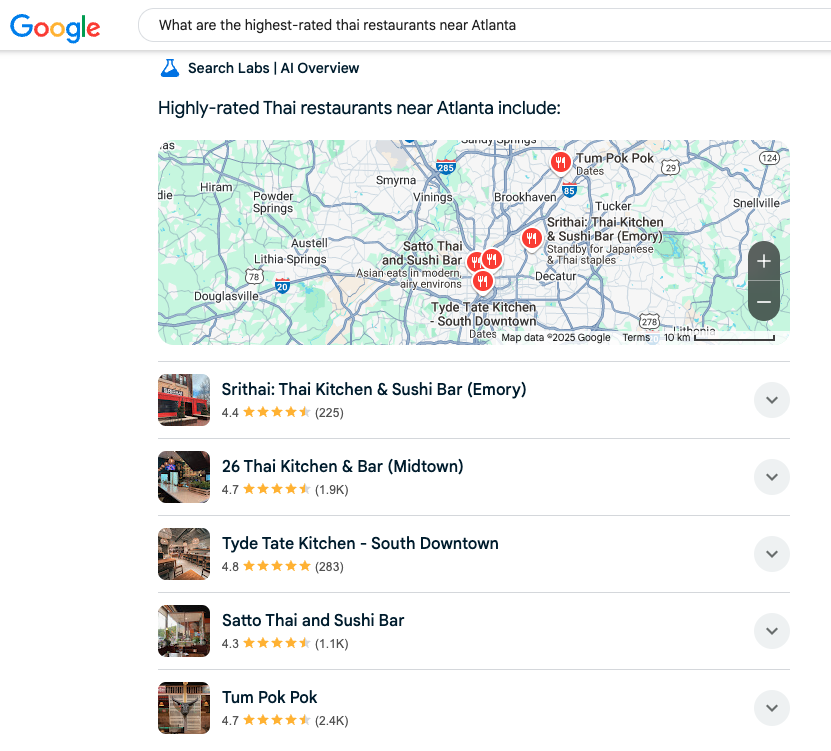
Use a heading like: “What are the highest-rated Thai restaurants near Atlanta?” and answer it concisely beneath.
2. Implement Structured Data Markup
Schema markup gives search engines explicit information about your content. When implemented correctly, it can make eligible pages available for supported search features. However, it does not guarantee placement in AI Overviews or People Also Ask.
Google recommends validating structured data with the Rich Results Test and using URL Inspection to confirm how Google sees the page.
Tools to help: Google Structured Data Markup Helper, Yoast SEO, Schema Pro
Best practices:
- Use schema for product pages, FAQs, reviews, and articles
- Validate with Google’s Rich Results Test
- Add local business, organization, and review schema to support trustworthiness
- Use FAQPage markup only when the page contains visible questions and answers that match the structured data.
3. Focus on High-Quality, Authoritative Content
Strong search visibility begins with helpful, reliable and people-first content. Google recommends demonstrating first-hand expertise, citing trustworthy sources and clearly identifying who created the content.
Tips:
- Publish in-depth, well-researched content with supporting data
- Keep pages updated with fresh statistics and industry insights
- Highlight the credentials of content creators and cite credible sources
- Link out to government, academic, or high-authority third-party sources
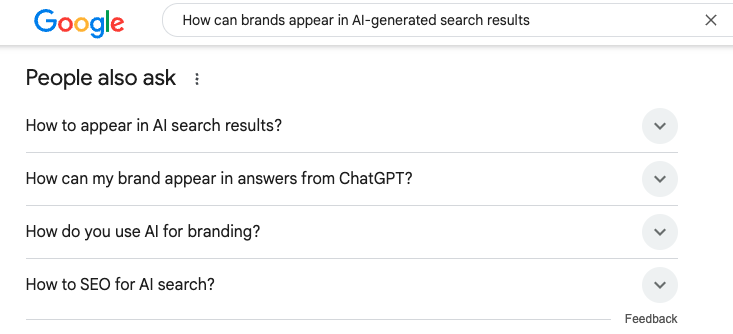
4. Target Google’s “People Also Ask” Section
Google’s PAA section is a valuable opportunity to appear directly in front of engaged users who are already asking related questions.
How to rank there:
- Use headers in the form of questions (H2 or H3)
- Answer each question in 2-3 concise sentences
- Use bullet points where appropriate
- Provide clear, direct, fact-based answers
- Refresh your content regularly to maintain rankings
How is AI changing digital marketing?
AI is changing how customers discover, compare and choose brands. Marketers now need clear, trustworthy content that performs in traditional search and can also be understood and cited by AI-powered platforms.
What does AI search mean for local businesses?
AI search can recommend nearby businesses based on relevance, location, reputation and available business information. Local companies should maintain accurate listings, earn authentic reviews and publish clear answers to common customer questions.
How can brands appear in AI-generated search results?
Brands can improve their chances by publishing accurate, well-structured content and demonstrating clear expertise. Strong technical SEO, descriptive internal links and credible third-party references also help search systems understand and evaluate the brand.
5. Leverage New Consumer Trust in AI Search
Source: Attest, 2025 Consumer Adoption of AI Report:
- 41% of consumers trust Gen AI search results more than paid search ads
- Only 15% trust AI less than paid ads
- Among current Gen AI users, 68% trust the information provided by AI tools
Demographic differences:
- Men are more likely than women to trust Gen AI search over regular search results (44% versus 37%)
- Younger users (18-30) are more AI-trusting than those 50+
- US/UK consumers are more open to AI than Canadian/Australian audiences
Source: Forbes, March 2025 — AI Search Results More Trusted Than Ads: What CMOs Need to Know
Implication:
Visibility in AI-generated answers can complement SEO and paid search by helping customers discover and evaluate a brand earlier in their decision process.
6. Create Content AI Tools Can Parse
AI tools pull from web content differently than traditional search engines. They prioritize clarity, structure, and verifiability.
Optimize with:
- Short paragraphs (2-4 sentences)
- Clear headings every 200-300 words
- Bullet points and numbered lists
- Use authoritative sources and avoid vague or sensational language
- Ensure mobile and desktop layouts are both clean and accessible
Bonus Tip: Avoid JavaScript-heavy pages. AI tools may struggle to interpret client-side rendering.
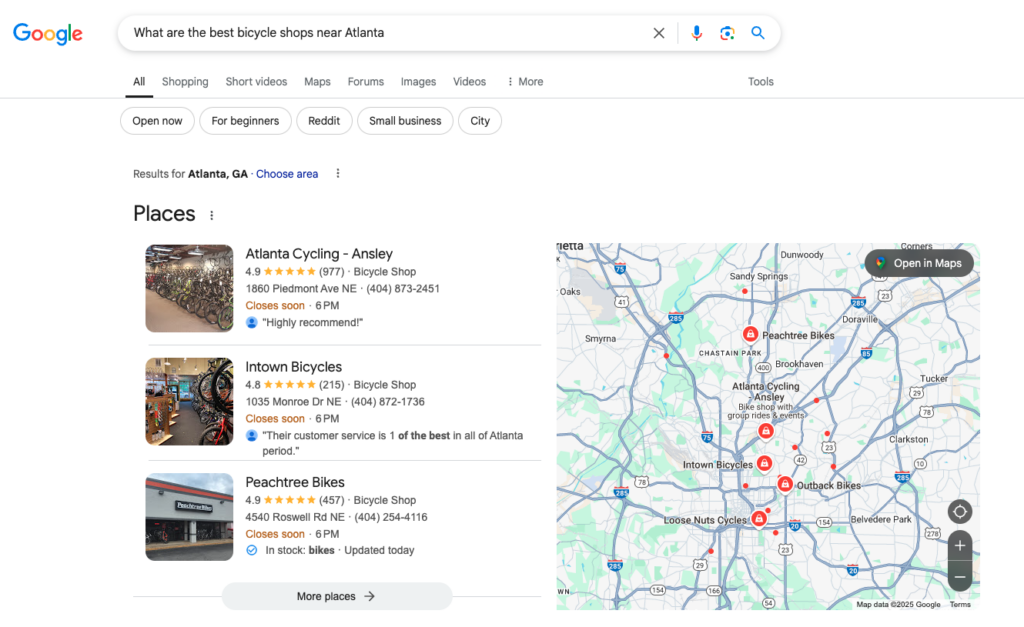
7. Enhance Local SEO and Online Listings
AI often delivers hyper-local results tailored to the user’s location and query intent. Local businesses primarily must ensure they’re being read and ranked correctly by AI.
Checklist:
- Consistent NAP (Name, Address, Phone) across platforms
- Up-to-date Google Business Profile with FAQs and services
- Fresh customer reviews and responses from owners
- Use Google’s Q&A feature and populate it with helpful information
- Claim listings on all major directories (Yelp, Bing Places, Apple Maps)
8. Prioritize Mobile and Voice Search Optimization
Google uses the mobile version of a site’s content for indexing and ranking. Therefore, businesses should provide the same useful content and structured data on mobile and desktop.
Optimize for:
- Fast page loads and mobile-responsive design
- Conversational voice-friendly keywords (“What’s the best… near me?”)
- Text alternatives for media
- Improve Core Web Vitals and use lazy loading for below-the-fold images
- Add alt text and ARIA labels to support accessibility
9. Embrace AI-Driven Personalization and Automation
AI is also a tool for marketers, not just a challenge. Use AI internally to:
Applications:
- Create dynamic landing pages based on user behavior
- Segment email lists and automate content personalization
- Run predictive analytics to identify purchase patterns
- Use AI chatbots for customer support and lead capture
- Track cross-channel engagement to adjust messaging in real time
10. Stay Ahead of AI Trends and Algorithm Updates
Implementing an AI search strategy for business owners and CMOs starts with optimizing your site for natural, conversational queries that AI understands. AI search is not a one-time project. Search platforms, customer behavior and competitive results continue to evolve, so businesses should review their strategy regularly.
How:
- Follow Google’s Search Central blog and OpenAI/Anthropic updates
- Use tools like Clearscope or MarketMuse for content scoring
- Re-audit and re-optimize your top content every 3-6 months
- Benchmark against competitors to identify SEO gaps
How to Measure Your AI Search Visibility
Unlike traditional SEO, where the ranking position is clear, AI search visibility is more nuanced. To evaluate your effectiveness:
Track using:
- Branded mention monitoring (tools like Brand24 or SEMrush)
- Featured Snippet tracking (Ahrefs, Moz, or SEMrush)
- PAA and FAQ appearances (via tools like AlsoAsked and KeywordTool.io)
- Voice search audits (test answers via smart assistants)
- Review Search Console data for impressions on question-based queries
Want a practical framework for improving your AI visibility? Explore the AI Search Playbook: How to Get Your Business Found, Cited and Chosen.
Summary: Your AI Search Strategy for Business Owners and CMOs
- AI is reshaping search, marketing, and customer acquisition
- Gen AI is gaining trust faster than paid media
- Structured, conversational content wins visibility
- Success measurement must adapt to include visibility in summaries, voice results, and chatbots
- Those who embrace and integrate AI now will lead tomorrow
Ready to Future-Proof Your Marketing Strategy?
AIS Media has helped businesses dominate digital search for nearly 20 years. We understand how to adapt traditional SEO to the rapidly evolving AI landscape.
Let’s work together to boost your visibility, drive more qualified traffic, and turn search into sales.
👉 Schedule Your Free Consultation
A forward-looking AI search strategy for business owners and CMOs involves structured content, measurable visibility, and ongoing adaptation to AI-driven technologies.
Together, we’ll ensure your business gets found—even in the AI era.