

Voice search optimization helps people find useful answers about your business when they speak a question into a phone or voice-enabled assistant. It combines clear website content, accurate business information, and a usable mobile experience so customers can understand what you offer and take the next step.
For a marketing leader or business owner, the practical question is straightforward: when someone asks about your services, location, or availability, can they find a clear and trustworthy answer? This guide explains how to improve that experience and measure the business results.
What voice search optimization involves
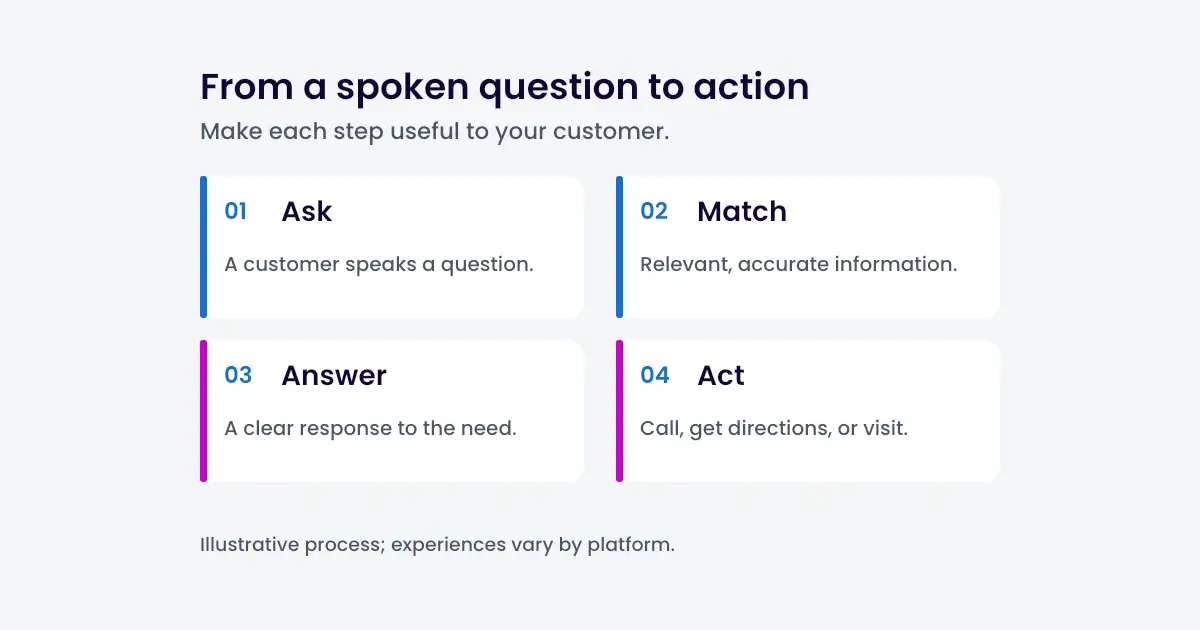
Voice search is an input method: a person speaks instead of typing. A spoken request might be a short phrase, a full question, or a follow-up in a longer conversation. Your content should address the underlying need, rather than force every sentence to sound like a voice command.
For example, someone might ask, “Who repairs decks in Atlanta?” A useful answer depends on more than repeating that phrase. The business needs a relevant service page, an accurate service area, credible information, and an obvious way to call or request an estimate.
Depending on the experience, the next step may happen through a website visit, a phone call, or directions. As a result, your strategy should connect search visibility with the actions that matter to your business.
How voice search connects with AI search
Voice search and AI search overlap, but they describe different parts of the experience. Voice describes how someone asks; an AI-generated response describes how a system may assemble an answer. A customer can type a question into an AI tool or speak a request that returns a conventional local result.
For Google AI Overviews and AI Mode, Google says established SEO practices remain relevant, with no special AI markup required. Focus on accessible, helpful content and accurate business information. Inclusion in any particular answer or result is not guaranteed.
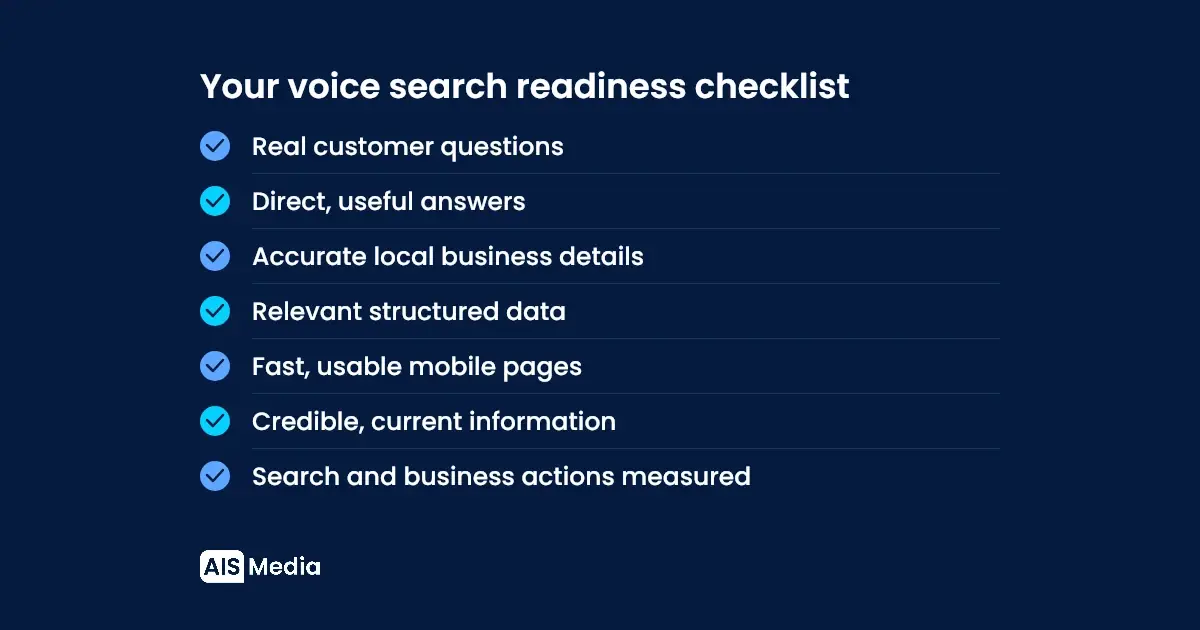
Seven practical voice search optimization steps
1. Start with real customer questions
First, collect questions from sales conversations, support requests, contact forms, and your existing search queries. Group them by what the customer needs to decide: which service fits, where you operate, what the process involves, and how to get started.
Then use keyword research tools, including BrightEdge, to explore related language and search demand. Treat those figures as keyword research; they do not automatically represent voice-only searches. Prioritize questions your business can answer with specific expertise.
2. Put a direct answer near each question
Use descriptive headings and answer the main question immediately. Follow with the details, examples, or conditions a customer needs. Clear answers also make pages easier to scan on a phone.
For a deck repair page, an answer might explain which problems the company repairs, where it works, and how it estimates the job. For a professional service, explain the engagement process and the information a prospect should prepare. Use only details that are true for that business.
There is no universal word count that makes an answer eligible for voice search. Keep the opening answer concise, then provide enough context to be useful. AIS Media’s content creation services can help turn customer questions into accurate, readable pages.
3. Keep local business information accurate
If you serve local customers, review your Google Business Profile alongside your website. Check your business category, phone number, website link, hours, and legitimate locations or service areas. Keep those details current, especially when availability changes.
According to Google’s local ranking guidance, relevance, distance, and prominence influence local results. Complete information helps customers understand your business, while genuine reviews and helpful responses support a stronger local presence. For more implementation detail, see our guide to local SEO for spoken customer questions.
4. Use structured data that matches the page
Structured data describes content in a consistent format. Use the types that fit the visible information: article markup for a blog post, and appropriate business markup for a page that describes a real business or location. Keep names, URLs, dates, and images consistent.
For example, Google’s LocalBusiness documentation explains how business details can be represented. Validate the markup you use and avoid adding information that customers cannot verify on the page. A generic “voice tag” is not a substitute for clear content and sound technical SEO.
5. Make the mobile visit easy
Next, test important pages on an actual phone. Customers should be able to read the answer, tap the phone number, understand the offer, and complete a form without fighting the layout. Avoid intrusive elements that cover essential information.
Use appropriately sized, compressed images; reserve their display dimensions; and load supporting visuals efficiently. Evaluate speed and usability with real page data and Google’s page experience guidance. Choose image quality and file size together instead of applying one arbitrary limit to every asset.
6. Make the answer worth trusting
Support your advice with first-hand knowledge, named authors, relevant sources, and specific examples. Explain important limits and keep service details current. When sharing a client result, identify the metric, time period, and context, and distinguish broader SEO work from any claim about voice search alone.
Also review older pages for unsupported statistics, obsolete product names, and promised outcomes. A clear explanation of how your business solves a problem is more useful than an unverified claim about market size or guaranteed rankings.
7. Measure search performance and business actions
Finally, review impressions, clicks, click-through rate, and average position for the relevant pages in Google Search Console. Compare similar periods and examine the queries behind changes. These measures describe search performance; they do not prove that a particular search was spoken.
Connect that view with qualified inquiries, tracked calls, and completed forms in your analytics and lead systems. Where relevant, review Business Profile interactions as well. This gives you a more useful picture of business impact than rankings alone.
Start with a baseline, record the improvements you make, and review the results consistently. For instance, a service page may gain visibility while still needing a clearer offer or contact process. Use that finding to choose the next improvement.
Frequently asked questions about voice search SEO
Is voice search optimization different from SEO?
It is a practical part of SEO that considers spoken questions and voice-enabled experiences. The work still depends on relevant content, accessible pages, accurate business details, and a useful customer experience.
Do I need a separate page for every spoken question?
Usually, related questions belong together on a useful service, location, or topic page. Create a separate page when it serves a distinct customer need and offers substantial information. Avoid thin pages that repeat the same answer with small keyword changes.
Will FAQ schema make my business appear in voice answers?
FAQ markup does not guarantee inclusion in voice answers. Keep question-and-answer content useful for readers, and make any markup match the visible content. Google discontinued FAQ rich results in May 2026, as recorded in its Search documentation updates.
Can I measure voice search traffic separately?
Do not label general keyword rankings or page clicks as voice-search traffic. Use the attribution your reporting tools actually provide, and assess search visibility alongside customer actions such as calls, inquiries, and directions.
Where should a business start?
Choose an important service page and the questions customers ask before contacting you. Improve the answers, verify the associated local information, test the mobile experience, and establish a performance baseline before expanding the work.
Turn customer questions into a practical search plan
AIS Media brings together SEO and AI search services, content development, and measurement to help businesses improve how customers discover and evaluate them. Start with the gaps that matter most: unclear answers, inconsistent business details, or a difficult path to contact.
Request a complimentary digital marketing review to identify practical priorities for your website and local search presence.