
Voice search optimization for 2027 builds on the process of making your website and business information useful when customers ask spoken questions. Also called voice search SEO, it combines clear answers, accurate local details, accessible pages and a usable next step. Today, that journey can involve conventional search results, conversational AI and assistance with the next action.
For CMOs planning for 2027, the opportunity is to prepare for how customers will discover, evaluate and choose providers. Can a prospect—or an assistant acting on their behalf—confirm that you serve their market, understand whether your offer fits and take the next step? Build the plan around those decisions and the qualified demand they can create.
This 2027 planning guide uses research and platform guidance available as of November 9, 2026. In particular, it distinguishes what is established today from our outlook for the year ahead, with practical actions to prepare. AIS Media’s SEO and AI search services connect that strategy with content, technical execution, local visibility and performance analysis.
Where voice and AI search stand today: the evidence for 2027 planning
The most useful starting point for voice search optimization for 2027 is a clear view of current behavior. These 2026 findings show why voice-enabled discovery deserves attention, while measuring different activities and audiences.
| Finding | What it measures | How to interpret it |
|---|---|---|
| 23.1% used a voice assistant in the past week | Internet users aged 16+ in GWI’s surveyed markets, reported in DataReportal’s October 21, 2026 release. | Includes finding information and completing actions such as playing music. It is not the share of searches conducted by voice. |
| 10% had used a voice assistant to purchase or reorder items | U.S. consumers in NIQ’s early-2026 Quick Question research, released May 5. | A voice-commerce behavior, rather than the share of all searches or evidence that an agent completed the purchase autonomously. |
| 42% had used AI chatbots to search for information | U.S. adults, Pew Research Center’s February 2026 survey. | This measures chatbot information seeking, whether typed or spoken. |
| 60% had read AI summaries at the top of search results | U.S. adults, the same Pew survey. | This measures reported exposure to AI search summaries, rather than voice usage or clicks. |
Sources: DataReportal’s Digital 2027 report, published in October 2026; NIQ’s May 2026 research release; and Pew’s June 2026 report.
What these numbers mean for your plan
Because these findings cover different populations, questions and timeframes, their percentages should not be added or treated as a trend. For example, NIQ reports a monthly sample of approximately 500 U.S. consumers, without exact field dates or weighting details in the release. Pew surveyed 5,119 adults. DataReportal’s public voice section does not disclose the question-level sample size and warns that a changed survey question limits historical comparisons.
The implication for marketing leaders: use these findings to inform discovery planning, then validate the opportunity against your own customers, services and markets. They do not establish how much of your category’s demand comes from spoken searches.
How does voice search optimization relate to SEO, AEO and GEO?
Voice search describes asking a search question aloud. Voice-assistant use also includes actions such as playing music or setting a timer. AI search describes a system generating an answer, which can follow a typed, spoken or visual request.
Marketers use answer engine optimization (AEO) for work intended to make information useful in direct answers, and generative engine optimization (GEO) for visibility in generated responses. In other words, these labels overlap with SEO. They describe discovery goals, while voice describes an input method; they do not create a separate Google eligibility standard.
For the broader business case, see AIS Media’s CMO guide to capturing demand through voice-enabled discovery.
This distinction matters when choosing channels and judging results. A B2B buyer researching implementation requirements and a consumer asking for a nearby service may need different information and conversion paths. Neither journey requires a separate page for every possible phrasing.
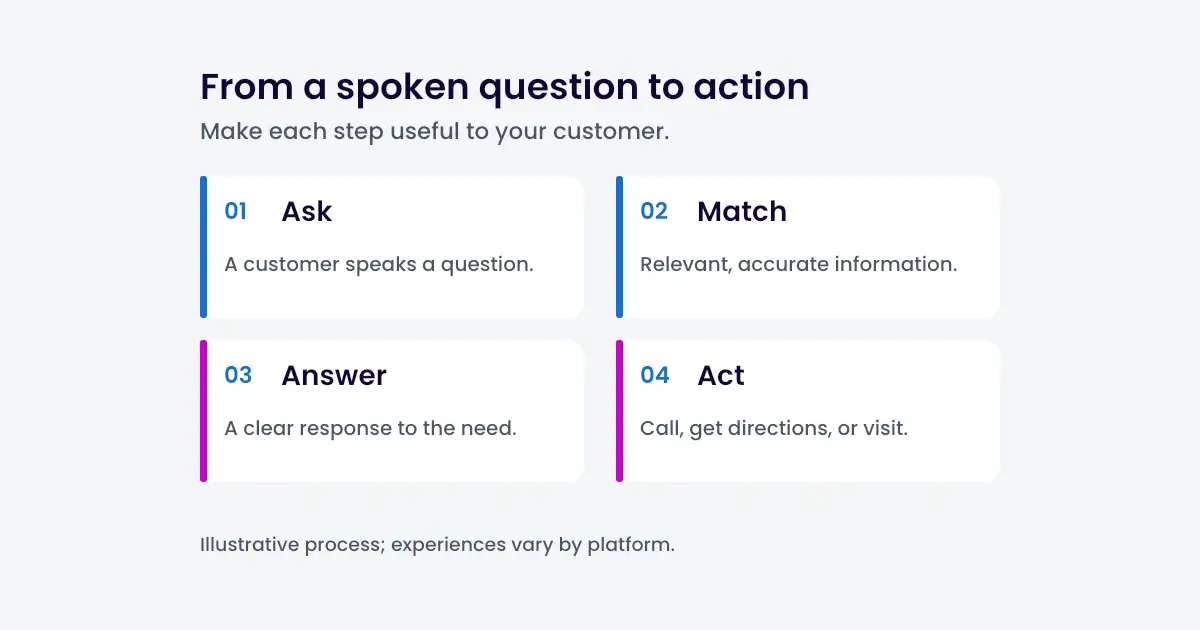
Voice-enabled discovery is becoming a conversation
On March 26, 2026, Google announced Search Live’s expansion to more than 200 countries and territories where AI Mode is available. In addition, the experience supports back-and-forth interaction using voice and a camera in the Google app.
Google’s May 2026 analysis of AI Mode use in the U.S. also describes longer questions and growing interest in planning and decision making. These are Google’s platform observations, rather than a forecast for every category or a measure of spoken searches.
Our strategic takeaway for 2027: plan for follow-up questions. Someone evaluating a provider might ask where it operates, whether it handles a particular requirement and how to request a quote. Therefore, your pages should make that sequence easy to understand, with current facts and clear links between related services and locations.
Availability and behavior vary by product, language, market and device. Test the experiences your customers actually use. For the broader leadership framework, read AIS Media’s AI Search Playbook.
What is likely on the horizon for voice search in 2027?
Our outlook is that voice will increasingly serve as an entry point into a broader conversation: a customer can ask, compare, clarify and move toward an action. However, the pace will vary by audience and platform. Use the developments below as planning assumptions to test against customer behavior in your own market.
| Signal today | 2027 planning implication | Prepare now |
|---|---|---|
| Search supports conversations using voice, text and images. | Discovery is likely to involve more follow-up questions about fit, location and requirements. | Connect clear service answers, useful visuals and accurate location information. Test the sequence from initial question to inquiry. |
| Agents can navigate websites and assist with tasks. | Some customers may delegate more of the research and next step. Useful information and a working action path become a shared responsibility. | Publish service criteria as readable text. Make calls, forms and booking routes easy to identify, with clear confirmations and appropriate customer control. |
| Generated answers can draw on information beyond a brand’s own page. | A brand may need to explain its value before a prospect visits its website. | Make expertise and evidence easy to verify: name relevant experts, explain service limits, maintain consistent business facts and substantiate case-study results. |
| AI visibility, search visits and qualified inquiries are measured separately. | 2027 investment decisions will benefit from a combined view of discovery and commercial outcomes. | Establish a baseline now. Review citations and answer accuracy alongside qualified leads, opportunities and pipeline, with attribution limits stated. |
These are strategic inferences from current capabilities and guidance. They do not establish a 2027 voice-search adoption rate or a product rollout schedule. Therefore, review the assumptions quarterly and adjust investment when customer evidence warrants it.
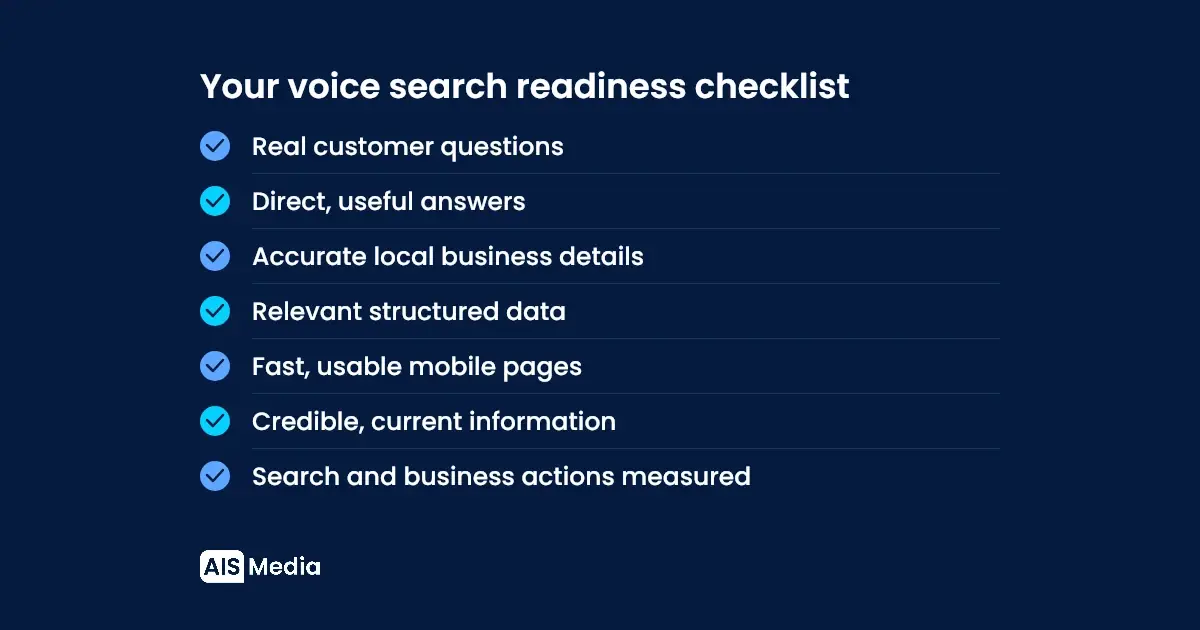
Voice search optimization for 2027: seven priorities for CMOs
Fund the work that improves discovery and the customer journey today: commercially relevant answers, accurate business information, accessible pages and a usable next step. Then use focused experiments to learn where new AI and agentic experiences can add value in 2027.
1. Start with questions that influence revenue
Ask sales and customer-facing teams which questions separate a qualified inquiry from a poor fit. Next, review conversations and existing search data for questions about service coverage, eligibility, availability, requirements and the buying process.
Then map each important question to a service or location page and a next step. For example, an Atlanta facilities manager asking about commercial HVAC maintenance needs coverage details, relevant capabilities and a route to discuss the building’s requirements.
In addition, use BrightEdge and other keyword tools to ground voice search optimization for 2027 in related demand and competition. Their general search volumes do not identify spoken queries. AIS Media’s digital marketing strategy services help connect those opportunities to business priorities.
2. Answer clearly, then add expertise buyers cannot get everywhere
Open with a direct answer to the page’s main question. Then follow with specifics: who the service fits, what the process involves, limitations and what a prospect should prepare. For example, use named experts, original examples and relevant client evidence.
Google’s current generative AI optimization guide emphasizes distinctive, useful content grounded in experience. It also rejects the idea that pages must be broken into tiny pieces or rewritten into a special AI format.
Commission content your team can substantiate. For example, explain a real implementation decision or a service constraint that customers often misunderstand. AIS Media’s content creation and SEO copywriting services help turn subject-matter knowledge into useful buyer guidance. There is no universal answer length that earns a voice result.
3. Treat local accuracy as an operating responsibility
Include local accuracy in your voice search optimization for 2027 plan. Check each Google Business Profile against the corresponding location page: category, address where applicable, phone number, regular and holiday hours, services and destination links. Finally, assign an owner who can update those facts when operations change.
Google identifies relevance, distance and popularity as the main factors behind local results. Complete information and genuine reviews help customers evaluate the business; they do not guarantee placement.
For a multi-location organization, confirm that every inquiry reaches the right team. A visible location with an incorrect service list or broken appointment link can waste demand your marketing has already earned.
4. Keep technical SEO and schema tied to supported uses
Technical readiness supports voice search optimization for 2027. Confirm that priority pages can be crawled and indexed, that important information is available as text and that related pages link to one another. Also use accurate Article or BlogPosting markup for editorial content and appropriate LocalBusiness markup for eligible business pages. Then match the visible information and validate the implementation.
Google does not require special AI schema. Its guidance also says that llms.txt does not improve Google Search visibility. Evaluate proposed technical work against a supported purpose and the customer problem it solves.
Also ask the Search Console owner to verify the site’s Search generative AI inclusion setting. Google’s default is inclusion, with inheritance possible from a parent property. In particular, check the actual setting alongside indexing and snippet eligibility when investigating missing AI visibility.
For ChatGPT search, ask your web team to check access for OpenAI’s OAI-SearchBot, including website and hosting protections. Search access is managed separately from GPTBot, which concerns model training. Access makes discovery possible; it does not secure a citation.
Keep useful FAQs, while recognizing that Google stopped displaying FAQ rich results on May 7, 2026. FAQ markup cannot secure a voice answer or an AI citation.
5. Make the next action work on a phone
Test a complete customer task on a phone: find the relevant service, choose a location, tap to call or complete an inquiry. Then confirm that the phone number connects correctly and that the form’s confirmation explains what happens next.
Next, resolve slow or unstable pages, unreadable text and intrusive overlays. Google’s page experience guidance supports improving usability, while making clear that good performance scores do not guarantee top rankings. Prioritize problems that stop qualified prospects from acting.
6. Review what an answer says about your business
Create a repeatable set of commercially relevant questions. For example, include the initial request and likely follow-ups about service fit, locations and next steps. Record the date, product, device, language and location context when reviewing answers.
Next, check factual accuracy, whether your brand appears, which sources are linked and whether the recommended action works. Then correct information on your own pages and business profiles first. Treat these reviews as diagnostic observations: answers can vary, and a small prompt sample does not measure market share or prove a ranking change.
7. Separate AI visibility, search traffic and business outcomes
For your 2027 baseline, use Google’s Generative AI performance report for Search. Google says it reached websites worldwide by August 31, 2026. It reports impressions in AI Overviews and AI Mode, with breakdowns including page, country, device and date; a site may need sufficient impressions before the report appears.
Use it to understand exposure alongside your existing reporting. It does not provide a voice-only traffic count or establish which leads resulted from an AI answer. The documented report measures impressions, rather than attributed clicks or conversions. Its data is included in overall Search performance, so avoid adding it to overall impressions as if it were separate incremental reach.
| Measure | What to review | Decision it supports |
|---|---|---|
| Discoverability | Relevant page visibility, AI-feature impressions and documented answer checks. | Which services or markets need better information and coverage? |
| Customer action | Search visits, tracked calls, completed forms and appointments. | Where does the journey lose potential customers? |
| Commercial value | Qualified lead rate, opportunities, pipeline and revenue where records connect. | Which improvements justify more investment? |
General Search Console clicks, keyword volumes and question-shaped queries do not reveal whether someone spoke. Review lead quality with sales or operations, compare similar periods and record concurrent campaigns. Report attribution gaps alongside results.
Which tools support voice search optimization?
Choose tools that support your voice search optimization for 2027 decisions. A keyword estimate, an AI citation and a qualified lead measure different parts of the journey.
| Job | Useful tools or records | What to keep distinct |
|---|---|---|
| Find relevant questions and competitors | BrightEdge keyword research, sales conversations and customer-service records. | Keyword volumes estimate search interest; they do not count spoken searches. |
| Review AI discovery | BrightEdge AI HyperCube, where relevant coverage is available, and documented answer checks. | Mentions, linked citations and prompt-demand indicators are different measures. An empty result does not establish zero demand. |
| Evaluate visibility and business value | Search Console, website analytics, call and inquiry tracking, and CRM records. | Appearances and visits need to be assessed alongside qualified actions and pipeline. |
Tools support research and diagnosis. Improving the underlying answers, information and customer journey is the work that follows.
What should CMOs watch as agentic search develops?
Agentic search can help someone research and continue a task, such as comparing providers or navigating a request process. Voice can start that journey. A useful answer is only one part of making the experience work.
Google’s web.dev guidance for agent-friendly websites emphasizes clear page structure, recognizable links and buttons, labeled form fields and stable layouts. For marketing leaders, that means asking whether a person or assistant can identify the right service and complete the intended next step.
For example, a facilities manager researching commercial HVAC maintenance may next ask about service coverage and how to request a site assessment. Therefore, publish those facts as readable text and connect them to a clearly labeled inquiry path. This is an illustrative journey, not a tested client result.
One development to monitor is WebMCP, a proposed web standard for exposing website actions to agents. As of the research cutoff, Chrome is testing it through a limited browser trial; broader adoption remains uncertain. Ask your web team to assess a small pilot where it could help customers complete a specific task. Continue funding accessible pages and reliable forms while evaluating emerging interfaces.
Turn the 2027 outlook into an action plan
Organize your voice search optimization for 2027 budget around core SEO and business-information maintenance, priority customer-journey improvements, and a limited budget for experiments with emerging channels. Finally, assign an owner and a business question to each investment.
- Before 2027: establish the baseline. Marketing and sales should select priority services, markets and customer questions. Record current visibility, answer accuracy, inquiry paths and lead quality. Identify gaps before finalizing the content and technology plan.
- First 30 days of execution: fix the foundations. Content, local operations and the web team should update answers, business facts and technical access, then test calls and forms. Keep a dated change log and confirm how inquiries reach the right team.
- Days 31–60: run a focused pilot. Improve a manageable set of pages or locations and review relevant voice, AI-answer and customer-task journeys. Agree success criteria before launching, including task completion and qualified inquiries. Record the platforms and contexts tested.
- Days 61–90 and each quarter: decide what earns more investment. Review discoverability and qualified actions against the baseline. Account for seasonality, other campaigns and sales-cycle length. Expand where evidence supports it; revise experiments that do not resolve a useful business question.
This is an evaluation schedule. Search changes and longer sales cycles may require more time to assess pipeline. Keep core SEO work moving while new interfaces develop.
What credible agency execution looks like
Ask a potential partner to explain how customer research becomes page improvements, who maintains location information and how reporting connects visibility with qualified demand. Request evidence with clear definitions and attribution limits.
AIS Media combines those disciplines through its SEO and AI search services. As a BrightEdge Certified Partner, our team uses search intelligence to guide priorities and evaluate performance.
In our American Health Imaging SEO case study, the network expanded from 18 to 32 locations during the engagement, while Page 1 Google rankings increased 406% and organic search traffic grew 185%. These are reported results from the broader SEO engagement, not isolated voice-search results. They illustrate coordinated work across research, content, technical SEO and local visibility; individual outcomes vary.
Voice search optimization FAQs
Is voice search optimization different from SEO?
It is part of a coordinated SEO strategy that accounts for spoken requests and voice-enabled experiences. Useful answers, accessible pages, accurate business information and a clear next step support that work. Priorities should reflect your customers and commercial goals.
How much voice-search demand should we assume for 2027?
The evidence available in November 2026 does not establish a universal share of spoken searches or a reliable 2027 forecast for your category. Use the cited findings as context, then prioritize customer questions, current discovery gaps and qualified inquiries in your own markets.
Will FAQ schema help us appear in voice answers?
It cannot guarantee inclusion. Google retired FAQ rich results in May 2026. Keep FAQs when they help buyers understand your offer; do not build the investment case around that retired search feature.
Should a business add speakable schema?
Google’s speakable documentation describes a beta for topical news answers, with U.S. English-language availability on Google Home devices. It is not a general requirement for getting service pages into voice answers. Assess eligibility and purpose before implementation.
Can Search Console measure voice search separately?
Its documented search reports do not provide a voice-only breakdown. The newer generative AI report measures AI-feature impressions, which also include interactions that were not spoken. Keep those visibility metrics distinct from traffic, lead quality and revenue.
Do we need a page for every spoken question?
Group related questions on useful service, location or topic pages. Create a separate page when it serves a distinct customer need and offers substantial information. A page for every wording variation can dilute the information buyers need.
How do I register my business for voice search?
Start with the platforms your customers use. For Google local discovery, maintain a verified, accurate Business Profile and useful location pages. For ChatGPT search, review search-crawler access. A listing or technical change does not guarantee that every assistant will recommend the business.
Can we mark a page as a featured snippet?
No. Google says its systems select featured snippets. Write useful, direct answers and support them with clear detail, but do not treat a particular word count or markup tag as a way to reserve that placement.
What should a CMO prioritize for voice search in 2027?
Choose a commercially important service or location with a clear customer journey and measurable inquiry path. Fix missing answers, inaccurate details and conversion barriers, then evaluate qualified actions before expanding the program.
Can an agency guarantee a voice ranking or AI citation?
No credible proposal should promise a specific answer placement. Ask for a defined scope, relevant client evidence, measurable objectives and reporting that states what the tools can and cannot attribute.
Connect voice search optimization for 2027 to qualified demand
Prepare for a customer journey that may move between spoken questions, generated answers and assisted actions. Start with the services and markets that matter most, address the gaps you can verify today and test emerging opportunities against measurable commercial goals.
Request your complimentary growth consultation with AIS Media. Bring your 2027 growth priorities, target locations and current lead-quality challenges. Speak with a strategist about discoverability gaps, the customer journey and a practical path to stronger search performance.